
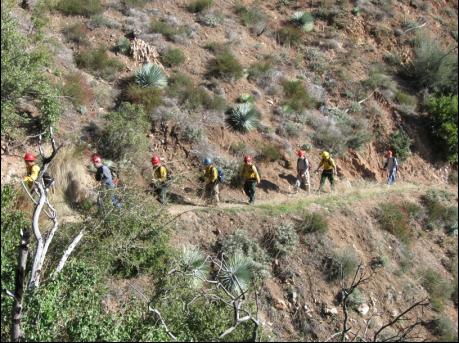
The
San Gabriel Mountains
Trailbuilders is the premier hiking trail restoration,
maintenance, and building volunteer organization in the
Angeles
National Forest. We work closely with the
United States Forest
Service to schedule work efforts within the
San
Gabriel River Ranger District of the forest, clearing trails, safely
dropping hung-up tree limbs to remove safety hazards, building wooden foot
bridges, clearing drainage culverts, building rock retaining walls, and a
lot of other activities suitable for volunteers to perform.
In the aftermath of the
Station Fire, volunteers are going to be sought which can assist in
the trail restoration process, felling burned trees that overhang hiking
trails, pulling down
"
Widowmaker" tree limbs that constitute hazards, re-establishing
trails through the burned brush, building soil retention walls, and numerous
other activities which will shorten the time needed to return recreation
opportunities to the region.
The information provided here describes how you may join in the effort,
what is required of you, and how things are traditionally done.
Working in the forest without pay is extremely fun and often rewarding, yet
it can also be difficult, demanding, and on rare occasion exhausting work
depending on what you feel comfortable doing. Because of this, information
about what you can expect when volunteering is provided.
The Trailbuilders work at minimum every 1'st, 3'rd, and 5'th weekend
of every month with additional days added to the schedule for
special projects. For the major restoration effort required after the
fire, the Trailbuilders may start to schedule restoration efforts every
Saturday and then relax the schedule eventually.
The current schedule is provided at the following web page:
http://www.crystallake.name/events.htm
For a review of some of the non-fire-restoration work that volunteers with
the Trailbuilders has done in the past, you can review the following web
page:
http://www.crystallake.name/twork/twork.htm
You may email the Trailbuilders at
(Email Ben) or
(Email Fred) to get more
information about when and where the Trailbuilders will be working and
how to meet up with us.
The Trailbuilders Official
Web Site also provides information about the organization and how to
volunteer in the Angeles National Forets.
Volunteering with the Trailbuilders goes much like the following. Things
change some times, of course, and we take things as they come. But this
is a general outline of a typical volunteer day:
There may be other activities that are done during the day, such as going
through the tools to clean and sharpen them, sorting through tools that
need to be maintained or repaired, sorting through the discarded metal,
wood, and other materials that are collected at the Rincon Fire Station for
cast-off tools and equipment that the Trailbuilders can referbish.
All of the tools, materials, and equipment for volunteering is provided
by the Trailbuilders, the Forest Service, or by the High Country Riders
(who provide horse and mule transport assistance.) Scout Troops, youth
groups, church groups and other organizations may also provide materials
for projects; volunteers themselves do not need to provide tools,
equipment, or materials.
If you have personal tools you would like to bring, please inform one of
the Trailbuilders so that we know what has been taken in to the field.
Your own personal chainsaws and other gasoline-powered tools must not
be brought to volunter efforts because such tools require a Forest
Service Safety and Compliance inspection and certification, and the
Trailbuilders like to have only gasoline-powered tools that they are very
well familiar with being used on volunteer projects.
Safety is the number one priority when volunteering in the forest, and
because safety is so important, a few things aren't allowed when
volunteering in the Angeles National Forest.
Chainsaw cutting work in the Angeles National Forest is restricted to
being performed only by volunteers who have acquired formal training and
certification, volunteers who must re-certify periodically to maintain
their safety awareness and technical abilities with chainsaws.
A number of Hot Shot fire fighting crews within the San Gabriel River
Ranger District provide such training and certification, all you must do is
telephone them, inform them that you desire such formal training, and see
if they can schedule a class. The
Dalton Hot
Shots,
Bear Divide Hot Shots,
and the Arroyo Seco Hot Shots may be able to either schedule
training for you else they can provide contact information on where you
might be able to acquire such training.
Chainsaw work typically consists of 3 or 4 crews, a trained, certified, and
experienced sawer who is qualified to fell and/or buck problem trees, and 2
or 3 swampers who assist with wedges, hammers, establishing firm ground to
work on, establishing escape routes for the feller, removing limbs as they
are cut from the main tree trunk, and rolling bucked tree sections out of
the work area as the sawer signals for such removal.
Sawers always without fail work with all the required PPE -- Personal
Protection Equipment -- which includes
Kevlar
chaps, hearing protection, eye protection, solid boot foot wear and
hard hat. Typically long-sleeve shirts are worn while cutting however
there are rare situations where the sawer may wish to keep the forearms
uncovered.
Chainsaw teams are required to have at least one shovel with them at all
times, a medical First Aid kit, at least one fire extinguisher, and a
field repair kit for the saw.
Swampers are more numerous than sawers because swamping is the more
difficult job. The ground under which the sawing is being performed
should be scraped clear of tripping hazards and escape routes should be
clear of obstructions, tasks that swampers are asked to perform. In
addition, swampers enter and leave the area of bucking to clear tree limbs,
bucked trunk sections, and other materials when the sawer signals that it
is safe to approach.
The sawer's training includes the expectation of being fully aware of
everything that is going on around the area being worked, including watching
what swampers and other people are doing, how they're standing, what
direction they're moving, paying attention to whether a swamper is
attempting to get their attention, looking up as well as around, all while
being fully aware of where the chainsaw blade is at all times.
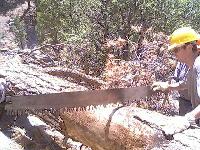
Crosscut saw cutting work in the Angeles National Forest is typically
done instead of chainsaws when the work to be performed is in a
Designated
Wilderness which precludes the use of power tools and petroleum-based
lubricants.
Crosscut sawing also
requires that a trained and certified crosscut sawer is working in the team
performing the work. Given the nature of crosscut sawing, trained sawers
will determine the lay of cuts and volunteers will trade off on the saw
back and forth as volunteers tire and rest up.
Training and certification opportunities for crosscut sawing is not
routinely provided by Hot Shot crews, and locating a facility which can
schedule such training is much more difficult than it is for chainsaw
certification. To become certified in crosscut saw work, you will need
to do some research for training opportunities in your area.
The Trailbuilders are currently (June 2010) attempting to acquire the
certifications required to train and certify other people and hopefully
the policies and procedures for doing so will be worked out this year.
With crosscut sawing, felling is always without fail done by certified sawers
whereas bucking and swamping is done by anyone who wants to volunteer for
that work regardless of certification provided a certified sawer is included
the bucking team. Crosscut sawing is just as hazardous as chainsaw sawing
so we always have a very experienced person included in all saw teams.
Bucking on the ground with crosscut saws is safe provided a trained sawer
is present and provides safety oversight while the bucking is taking place.
Swamping on crosscut saw work is less demanding than with chainsaw work
since the pace of the work is much slower.
Violence, alcohol, firearms, loud radio music, and other anti-social
behavior is forbidden. In fact any kind of safety-related misbehavior
will result in an abrupt ending of the work day for everyone.
Everything else that a volunteer might like to do and feels comfortable
doing can be done and very often volunteers will decide for themselves
what to do and how they want to do it. The Trailbuilders provide safety
and experience as well as instruction on how things can be done when asked.
Usually the Trailbuilders will review what needs to be done and volunteers
are left to figure out how to do things on their own unless they ask for
suggestions or unless the volunteer is doing something that may not be
safe.
Volunteering is much fun and is always rewarding, more so when a volunteer
was not sure he or she could do the work and discovers within themselves
capabilities they were unsure of. The tasks people perform are directed
and scheduled however each volunteer is free to take on tasks or set them
aside as they wish, the only dictate being that safety is the primary
overriding goal of the day.
The United States Forest Service is always looking for dedicated volunteers
who wish to donate their time and effort in a wider variety of tasks which
are suitable for volunteers. That includes manning Information Centers,
providing information to forest visitors, collecting trash, hauling trash,
swamping out toilets, removing spray paint, performing hiking trail
surveys, performing safety patrols, working on fire mitigation projects,
and a lot of other things.
Being a Federal Volunteer requires dedication and hard work as well as
periodic training. As an example, you can acquire a governmental driving
license to assist in trash hauling efforts, equipment deliveries, and other
activities that require the use of USFS vehicles.
If you would like more information on how to become a USFS Volunteer within
the San Gabriel River Ranger District, contact:
Lois Pickins (USFS), Volunteer Coordinator
A lot of activities are performed by volunteers who come out with the San
Gabriel Mountains Trailbuilders, but how exactly is such work done? This
information lists some of the tasks that volunteers may do with descriptions
of how the Trailbuilders accomplish such work.
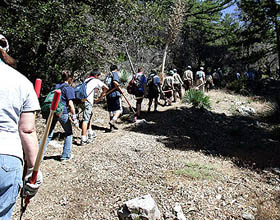
Trail maintenance generally requires hiking along a trail, removing rocks,
boulders, branches, rock slides, downed trees, berms along the trail, and
other clutter which either obstructs the trail or impedes a hiker's
reasonably safe progress along the trail.
When the Trailbuilders work along the San Gabriel River, crossing the
river is something that usually must be done, and at some periods during
the year the water level can be very high. In such cases the experienced
and trained Trailbuilders will mitigate the swift water hazard by
stringing ropes across the river for volunteer use.
Trailbuilding at times can be a growth experience for people who have
never done such things before, and younger kids who volunteer have in the
past found strength and courage they did not know they possessed.
When it comes to first-time experiences, volunteers may or may not be
informed in advance of what the day's effort includes, but always
volunteers are asked to do only what they feel comfortable doing.
Water flowing down the center or sides of the trail is one reason why
trails go bad and require maintenance. Some trail groups install
water-bars to try
to slow down the flow of water. The Trailbuilders generally like to
divert water off of the trail by cutting trenches in to the berm on the
outside of hiking trails instead of installing water-bars however when
conditions require them, the Trailbuilders will create water-bars.
Rock slides are a constant problem in the Angeles National Forest where
the granite is highly friable and slides are common. Along some trails,
endless rock, dirt, and sand continually come down and such materials must
be removed from the trail and, as time permits, materials are dragged down
from the hillsides proactively and then get removed from the trail.
Plants that like to grow in open sunlight like to grow on foot paths and,
as much as it is unfortunate to do so, plants must be uprooted or (if they
are pine or oak saplings that the volunteer would like to save) be
transplanted somewhere safe. One of the most common stabbing plants that
gets removed from trails are
yucca and occasionally
we will remove poison
oak from trails.
When a lip forms along the outside part of a trail, the berm may be removed
using shovels so that water can flow off of the trail and in to the canyon
below rather than flow down the trail to make runnels. Likewise if trenches
form along hillsides due to water flowing along the inside of the trail,
volunteers may decide to re-slope the grade so that the incline allows
water to flow off the trail rather than along the hillside.
This kind of trail maintenance employs shovels, picks, and
McLeods as
primary trail working tools with
Pic Maddox and heavy
metal rock bars being used as needed.
Some trail maintenance is done such that the trail is completely clean of
wood chips, pine needles, pine cones, leaves, or small stones. Other trails
may be left lined with rocks but much of the dried pine leaves and oak
leaves left on the trail. The impulse is to scrape everything off the trail
completely however that's not always desirable or needed if the trail is
well defined and the dead fuels on the trail are thin.
Downed trees, hanging trees, dead-falls and snags are removed either using
hand saws, chainsaws, crosscut saws, or just plain heavy dragging and
hauling by hand to remove the obstructions off of the trail.
Chainsaws are operated by trained and certified operators who utilize
swampers to perform the heavier work of cleaning out the downed tree after
it's felled, bucked, delimbed, and ready to be hauled off of the trail.
Swampers are also responsible for digging under tree trunks to afford a
cavity safe for the chainsaw to use so that the saw does not bite in to
dirt.
If you think that swampers aren't kept busy enough, they also have the
added duty of bringing along a fire extinguisher and a medical kit while
sawing is being performed to ensure that if the hot saw some how throws
a spark through its arrestor, any fire or spark on the ground or brush
can be extinguished (after which the saw's use is discontinued and the
entire area is monitored and/or dug up and treated with water just to be
sure everything is out cold.)
Typically the certified sawer may perform field maintenance on the saws
being used as needed, ensuring gasoline and chain oil does not run out,
keeping the machines clean, swapping out dull chains for sharp ones,
maintaining proper tension on the chain, allowing the saw to cool off
when needed, and other such maintenance of the saw.
Hatchets and axes may be used to remove bark and limbs from trees that
are to be bucked up in to sections. (High School students tend to enjoy
this kind of rather violent, destructive, yet useful work!)
To move very large boulders, a device called a
Grip
Hoist is used, or heavy metal rock bars are used. When a Grip Hoist
is used, a long metal braided cable is run through the Hoist, one end of
the cable carries a hook which can collect links of chain wrapped around
the boulder while the other end of the Hoist itself is attached to a large
tree to anchor the Hoist using a wide cloth webbing to protect the tree.
As volunteers pump the handle on the Hoist, the boulder moves easily, an
inch or so with each stroke. Volunteers can move massive weights with
this tool and the Trailbuilders has two of them and lots of cable and
slings as well as other equipment used with the hoists.
While not entirely considered "trail maintenance," pulling down
hanging tree limbs,
"
Widowmakers" and dead or burned trees that constitute a safety
hazard is another aspect of volunteer work that is done in the forest.
Always without exception this type of activity has a senior, very
experienced trail worker performing safety oversight for the effort,
relying upon volunteers to stay alert and aware and to follow suggestions
offered by the safety oversight while the hazard is being removed.
Hanging trees or limbs are evaluated by everyone in the team dispatched
to take care of the hazard. Everyone discusses the best possible way to
bring down the hazard safely, slowly, and carefully. The options are to
cut limbs with saws, attach ropes to pull things down, use a Grip Hoist to
pull everything down safely from a distance, or to leave the hang-up in
place if they do not feel comfortable addressing the problem.
While bringing down safety problems, if the effort is not working or there
are any concerns about continued safety, the effort can be abandoned.
Professional USFS employees might decide to return and use explosives to
eliminate a safety hazard after which volunteers may be asked to return
and clean up.
The Trailbuilders do most of their volunteer work clearing existing trails
and working in existing infrastructure -- bridges, stone foot paths, Visitor
Centers, trail signs and such. New trails are established at the behest
of the Forest Service when requested, either to provide access to newly
installed toilets or to provide a safe access to streams and rivers,
filling in and blocking off unsafe trails while doing so.
New trails are created by first starting with survey trips to the proposed
site. There, a
clinometer
is used to measure the inclination of a proposed path, line and
flagging is
laid along the proposed trail, and then much discussion takes place with
the line going back and forth until some kind of a consensus is reached
after which tools are used to carve a line through the ground.
Over several week ends the new trail takes shape by digging out and removing
material from the hillside until a shelf is created. Switchbacks may be
established, rock retaining walls may be built with rocks, brush may be
uprooted, and on rare occasion tree limbs may be trimmed back (we do not
kill living trees.)
The Trailbuilders have built a number of bridges, three of them wonderful
wooden foot bridges, two of which are behind the Rincon Environmental
Education Center 12 miles up Highway 39, and the other of which spans
Laurel
Gulch along the East Fork of the
San Gabriel
River.
Bride building involves working heavily with the Forest Service to acquire
and approve design plans for the new bridge, getting authority to proceed,
making sure all the paperwork is in order, and then acquiring the materials
to build the bridge.
Typically preparation work is performed at the Rincon Fire Station where
wood and materials are staged, pieces cut according to plan, drilled,
painted with sealant, and then carted to the site for assembly.
The footings for bridges may require much more work than the actual bridges
themselves. For the Rincon Education Center bridges, one of the bridges'
foundations are a great many heavy concrete dog-bone blocks with a rebar
infrastructure that ties it all together and then ties to the bridge itself.
For such a foundation, many long concrete blocks are moved by hand, many
tons of rock and gravel are collected in buckets and brought to the site,
lots of digging, measuring, and foundation building takes place even before
the bridge's main cross supports are placed in to position, then the bridge
is assembled, screwed and bolted in to place.
Rock walls may be built along hillsides, switchbacks, or other places to
stop dirt and rock from falling on to the trail or on to a road. The
Trailbuilders will build walls by collecting very large boulders and the
largest rocks that can be carried, then the wall is assembled by stacking
and fitting.
Typically most volunteers for this kind of work are dispatched to the
surrounding region to find and haul rocks and boulders while some volunteers
dedicate their efforts to the actual stacking and fitting of rocks.
Drainage culverts under
trails or under dirt access roads can cause water to stack up behind them
and flood the trail, causing runnels. Clearing culverts is usually
accomplished quickly and easily except for cases where a whole lot of
dense brush, tree limbs, or boulders have accumulated to clog culverts.
Culverts are cleared one stick at a time, peeling away the layers of
clogging material one layer at a time until the culvert is clear.
Typically one or two people can perform this kind of work though having a
spare to take over while other people rest is useful.
Collapsed culverts can't be fixed by volunteers unless the USFS provides
assistance with either a trenching machine or a tractor, providing a new
culvert pipe and hauling away the crushed one.
Streams that cross hiking trails may become clogged with dead, matted
brush which causes the stream to be redirected down the trail instead of
across the trail. Volunteers go in there with rakes, picks, and gloved
hands to clear out the stream, establish a small pool which animals can
drink from (or volunteers can cool off in) and clear drainage so that the
stream continues on its way off of the trail.
In the aftermath of fires, streams will become clogged and the path of
streams may change. Volunteers evaluate clogged streams and will decide on
the site whether to clear them or where to scrape out a suggested path that
the water might take.
Volunteers are some times asked to remove combustibles from around Forest
Service buildings, signs, along roads or other places where a carelessly
thrown cigaret might cause a fire. Such work is more often done by
processional, paid crews however along hiking trails and within camp
sites, volunteers may perform such work.
Raking up pine needles and pine cones, establishing a 30-foot wide fire
break around buildings, and generally clearing up brush and such is more
than just uprooting plants and making a pile of the fuels that have been
accumulated. The piles of materials must be relocated, either carried in
burlap sacks to a road for collection in a vehicle else hauled down a
canyon to be spread in areas that are not easily accessed by people
dropping cigarets.
The Trailbuilders are pleased and privileged to have the opportunity to
have the High Country Riders provide horses and mules for some projects.
Volunteers can assist in equipping the animals, learning from the High
Country Riders how to safely and comfortably pack their animals.
Animals carry the heavy stuff in to a project and then can carry most of
the tools and equipment back out. Additionally the volunteer animals can
carry drinking water, cooking stoves for overnight efforts, saws and other
equipment in to and out of the work site.
Anything that can be safely carried on the backs of horses and mules means
less weight carried on the back of human volunteers, and that means that
volunteers are less tired once they get to a work site so that they can
accomplish more work once there.
Volunteers will break up illegal rock dams across streams and rivers,
collect mountains of garbage from along the San Gabriel River, perform
carpentry on Visitor Centers, sand and paint tables, sand and paint
benches, repair wooden fences, block hikers from using trails when
hazardous maintenance is going on along the trail, and just about
anything else you might think of that the Forest Service might ask of
volunteers.
The San Gabriel Mountains Trailbuilders have people who have extensive
skills and experience as well as training, commitment, dedication, and
knowledge about everything that is asked of them. Volunteers who join
such efforts in the forest can learn how the Federal United States Forest
Service likes things to be done, providing hands-on experience for
eventual resumes seeking employment.
The things that are done, the tools and equipment that are used depend
upon weather, priorities, how many volunteers show up for an effort, and
other factors. Volunteers will find such work fun, rewarding, perhaps
difficult, at times exhausting, but always finishing the day with a sense
of accomplishment.
Some projects can not be accomplished in a single day so overnighters are
some times scheduled. Usually when there's an overnighter, some volunteers
spend the night and resume work the next day, some return home after the
first day and return the next, and some volunteers do not return the next
day. It's up to the volunteer to decide what he or she wants to do.
Overnight projects involve sleeping in the field which requires that the
USFS Volunteer Coordinator be made aware of the fact and also requires that
a Trailbuilder or USFS employee be on hand with a radio which can be used
to contact Dispatch as a safety measure.
Sleeping in the field is not entirely like a regular overnight campout with
friends and family since you will have tools and equipment with you, some
of which will need to be guarded against mice, bears, deer and other humans.
Additionally when working overnight with gasoline powered tools, someone
must adopt safety oversight for the overnight storage of gasoline, oil, and
other solvents that might be disturbed by forest critters.
The Trailbuilders tend to have cold camps, not having camp fires at night
since we are on the trail outside of permitted camp fire areas. We like to
camp within easy walking distance of running water (well I do, anyway!) for
cooling off and washing in, but far enough away to not disturb our fellow
forest critters who come to drink.
Hiking along ridgelines and sleeping in the forest during work efforts
also must take in to consideration the possibility of lightening or other
adverse weather that may come in. The Trailbuilders work in any kind of
weather including sleet and snow, tailoring the day's efforts depending
upon safety requirements imposed by the weather.
Situational awareness for safety also means adjusting work behavior and
sleeping locations based on the possibility of lightening or upon falling
trees or tree limbs in the night. Because of this, overnight efforts tend
to make camp in the open but not on ridge tops, mountain saddled, or
mountain peaks.
I hope that this information provides a summary of what volunteers can
do and how their efforts would be utilized. If there is anything unclear
or if you think of anything that should be added to this web page, please
send me an email and I will update the web page with my thanks.

A Typical Volunteer Day


What you should bring

What You Can And Can Not Do While Volunteering
Volunteering: The Next Level
San Gabriel River Ranger District
110 North Wabash Avenue
Glendora, CA. 91741
(626) 335-1900
What Work Gets Done and How Is It Done
Trail Maintenance

Trail Safety Improvements
Trail Building from Scratch

Bridge Building and Maintenance
Rock Retaining Wall Building
Culvert Clearing
Clogged Stream Clearing
Fire Mitigation / Patrols

Horse and Mule Assistance
Everything Else

Overnight Efforts
Final Roundup
This web site is not operated or maintained by the US Forest Service, and
the USFS does not have any responsibility for the contents of any page
provided on the http://CrystalLake.Name/ web site. Also this web site is
not connected in any way with any of the volunteer organizations that are
mentioned in various web pages, including the
San Gabriel Mountains
Trailbuilders (SGMTBs) or the
Angeles Volunteers Association
(AVA.) This web site is privately owned and operated.
Please note that information on this web page may be inaccurate.