
Laurel Gulch: North 34 degrees, 15.536 by West 117 degrees, 44.801
at 2313 feet.
Happy happy joy joy, today was a great day out with the San Gabriel
Mountains Trailbuilders, complete with a warm gentle rain, video footage
of the existing Laurel Gulch bridge, and a swift water river rescue
conducted by the intrepid and always handy Wayne!
My morning began much like most mornings with an orange tabby
polydactyl cat
stepping on my face and calmly and politely informing me that breakfast
time has arrived and that I should "get up and feed me before I get
violent." (I know exactly what my cats say when they meow and it's
often not very polite.)
After the cat was fed I crammed cold weather gear, batteries, a borrowed
video camera, medical kit, water, and an old box of crackers (only two
years past their expiration date!) in to my rugged and very manly
mouse-chewed tool backpack, climbed aboard my borrowed bicycle, and
started pedaling my way toward the Gateway Information Center just at
the base of the San Gabriel Mountains along Highway 39.
This was the first time I had bicycled along Sierra Madre above Azusa
in the daylight since the multi-million dollar residential home building
started up there several years ago. Today as I worked my way along the
road I got to wonder in amazement at all the empty houses that nobody can
afford, many of them unfinished and kind of open to the morning's rain.
In fact I was so busy watching the houses that I accidentally climbed a
curb at high speed and lost control of the bicycle for a few seconds, my
mind already plotting the avenue of my trajectory and planning to roll on
my left shoulder this time since, well, last time I crashed really badly I
mangled my right side and a left-handed mangle would even me up -- or so I
hoped.
Instead I got control, swerved in to the middle of the street, turned
around in the saddle and gave that curb my middle finger! The rest of
the trip to the Gateway Center was uneventful, and there I met Ben, Wayne,
and Tom and together we headed up the mountain, along East Fork Road, past
the Forest Service gate, and on in to
Heaton Flats
where we parked.
Busy! Lots of people were hiking on East Fork Trail today, many of them
heading for the Bridge To No Where to do some bungee jumping but most people
spending the day either hiking in to the back country or heading to the
river to do some gold mining. Even though it was early there were a lot
of hikers who had been in the back country before daylight and were already
hiking back to the trailhead.
We hiked from Heaton
Flats to Laurel Gulch, taking a look at river crossings and the general
lay of the trail and the river, trying to get a feel for difficulties that
horses and mules might have during the days when we would need their help
carrying in the materials and equipment we would need to establish the
bridge footings and then build a new bridge at Laurel Gulch.
And of course when we hike a trail we look at the condition of the trail
and get a running assessment on what the effort would be to fix spots that
might be more dangerous than is reasonable in the wilderness. In fact we
crossed cliff faces where toe-holds are common when we could have waded
along the river, and in truth I didn't see any part of the trail that
absolutely was required to be open and passable since people can walk
along the river if they must.
Still, there are a lot of places that could use some basic trail work --
cutting back brush, yucca plants, removing rocks from the trail, moving
downed tree limbs, the usual very basic things. Though we only went so
far as Laurel Gulch this time out we did not encounter anything major --
no large snarls of impassable tree limbs, no difficult rock or mud slides,
nothing that would need emergency maintenance.
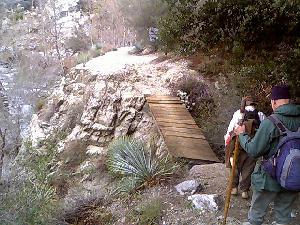
When we got to the bridge I had to look at it and laugh a bit since the
platform is two ax-felled telephone poles with good solid wood planks laid
across and nailed down, all drunkenly twisted and leaning on one side. The
bridge belongs in an Indiana Jones movie where the hero and heroine are
being chased by the bad guys and the only bridge to safety is -- well, the
one at Laurel Gulch.
We got photographs and video of the surrounding area where we will be
staging up materials and equipment for the bridge building project, making
notes of where the helicopter can land things, where horse team members can
unload things, where volunteers can sleep at night, and where water could
be pulled up from the river for the concrete, washing, and other needs.
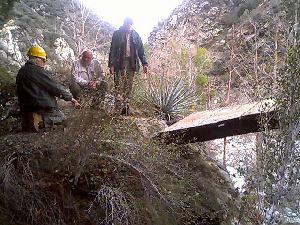
Tom and Ben took a careful look at the ground on either side of the Gulch
where the concrete footings will be built, trying to estimate how much
dirt and granite must be excavated and trying to get an estimate at how
friable the granite that must be removed is to get a feel for how many
hours of volunteer effort are needed to clear the ground for the concrete.
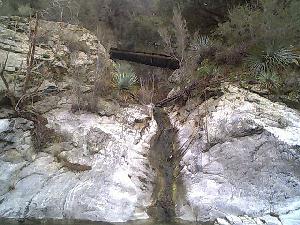
The actual work itself should not be all that difficult. Hauling the water
up might be the hardest part of the job, perhaps, since the river is at the
bottom of a 30 foot cliff and though we might be able to find a gasoline
powered water pump that can lift water that high in a pump package that
can be hauled in by a horse, it seems far more likely that all the water
will have to be brought up in buckets conveyed on a rope.
Still, however we actually do each task for the project I doubt that there
will be anything that's actually difficult. We may have to tie back the
overhanging tree limbs so afford the helicopter a better look at the gap
across the Gulch, or we may actually have to trim some of the tree limbs
back -- which nobody wants to do. But all of the technical aspects of the
project should not be difficult, just requiring a certain number of hours
for volunteers to complete at their own pace.
The camping area for volunteers will probably have to be down along the
river bed since the open areas around the bridge is going to be used for
equipment and materials, probably. There are plenty of camping areas near
the work site in the
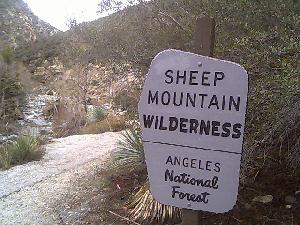
Designated Wilderness
which begins just about 40 feet from the Gulch. We will get a fire permit for
the nights needed and hopefully there will not be any fire bans in effect
since it would be nice to have a hot meal with sliced avocado at night after
a day of hard work.
Measurements were made, drawings were drawn, plans were laid (all while I
laid out on the broken asphalt roadbed and used my old leather hat to doze
under while the rain came down and everyone else worked) and then we packed
up and headed back toward the trailhead.
The old existing bridge, it was decided, can stay in place while the footings
are being built, allowing hikers to continue to use the bridge. The
helicopter can lower the new bridge right on top of the footings and the
existing bridge and once the new bridge is reassembled and securely fixed
to its footings, the old bridge can be removed from under the new bridge,
that way hiking across the gulch will not be disrupted.
The rain came and went though unfortunately it was mostly went. I tend to
like a lot of cold rain when I hike and had been putting in my vote for a
lot of it this morning but alas we didn't get much, certainly not enough
to make any of us cold and miserable -- which I enjoy. Still, the weather
was simply awesome for the day, not too cold, not hot at all, and a really
good day for a hike.
On the way back we took GPS readings of possible horse crossings where the
river is wide, shallow, and with fairly even rock footing that perhaps
horses and mules would not find too troublesome. People must cross the
river a number of times to hike East Fork though I suppose if one wanted
to make a hazardous trip, they could climb the embankment and avoid the
water.
Toward the end of the trail at the first river crossing someone had set
down a long narrow tree limb across the water and while most everyone
ignored it and walked across the river, occasionally someone would try
to cross along the tree limb -- which didn't look very safe to me. The
Trailbuilders waded across and then paused to rest awhile -- and I got
good video of a guy using the narrow tree to cross, hoping I might be
able to film a cold dunking.
I know, hippie types like me are supposed to be crammed packed with love
and peace and well-wish for my fellow human begins, hugging trees, kissing
little fury forest creatures (when we can catch them) and not at all the
type to harbor hope of video taping some poor fellow loose his footing,
twisting around acrobatically in the air before falling face first in to
the river but, well, in my defense I claim to have been raised by wolves
so I gleefully waited for the final and inevitable cold ending.
What actually happened was that Wayne and Ben walked over to where the
tree crossing was taking place (someone on the camera is heard to say,
"Nudge him in!") and Wayne lent a hand to the crosser who made
it safely to the other side, shoes and socks presumably still dry.
The Trailbuilders packed up and headed to the Rincon Fire Station, home
of Engine 22 where we moved some tools around, got something to drink,
and then called it a day.
Heaton Flats campgrounds: North 34 degrees, 14.514 by West 117
degrees, 45.674 at 2002 feet.
First river crossing suitable for horses: North 34 degrees, 15.113 by
West 117 degrees, 45.581 at 2104 feet.
Rock face the Trailbuilders might want to establish a path along: North
34 degrees, 15.388 by West 117 degrees, 45.375 at 2078 feet.
Second possible horse crossing: North 34 degrees, 15.453 by West 117
degrees, 45.015 at 2233 feet.
Laurel Gulch: North 34 degrees, 15.536 by West 117 degrees, 44.801
at 2313 feet.
Another possible horse crossing, this one on the way back down: North 34
degrees, 15.492 by West 117 degrees, 44.846 at 2407 feet.
Wayne's GPS Stuff:


 Wayne's GPS and Topo Mapping
 The start of the hike in to Laurel Gulch
 Most of the hike is along the river
 We get cool cloud coverage, rain, and fog
 Many people are mining in the river and hiking
 Lots of people are swimming in the river
 We spread out along the trail
 More people having an early lunch down by the river
 Swimming in the cold water appears to be fun for a lot of people
 We continue to hike in
 Lots of trees that survived the 1939 flood
 At one of the river crossings, this one hopefully can be used by horses
 Lots of downed trees along the riverbed
 Many trees have falled during the last big winds that came through
 The riverbed looks a lot like this -- rocks and tree limbs
 A view of the river from the trail
 A view of the river from the trail
 A view of the river from the trail
 To stay out of the river we walk along the rock face of cliffs
 Some trail maintenance has been done before, note the loppered branch
 Another section where we walk along the rock face
 There are not many living trees remaining
 Here is a tree with lots of mistletoe hanging on it
 A lot of the rock continues to clive off of the mountain and tumble down
 We take a look at the newly fallen boulders
 Many trees that still live are denuded for the Winter
 The hike in continues
 Aother look atthe river where we must cross
 Our first look at the existing bridge
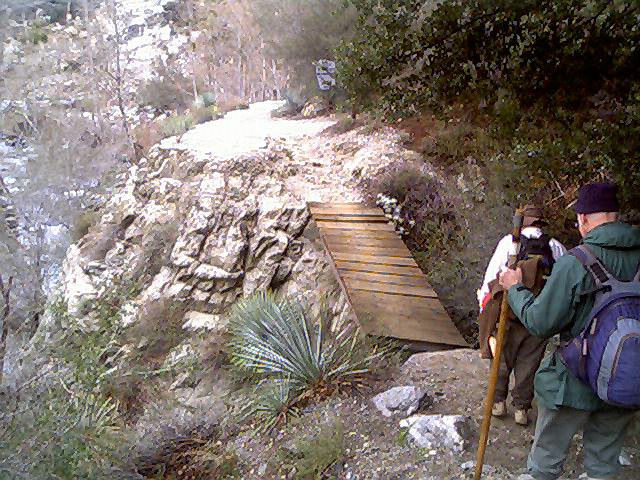 A closer look at the bridge
 Sheep Mountain Wilderness sign not far from the bridge
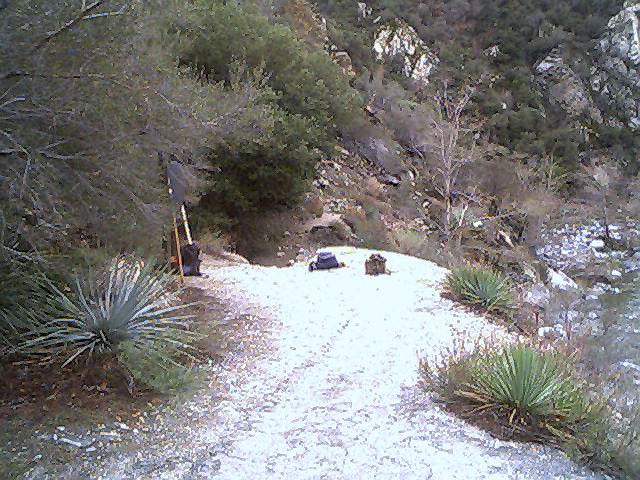 This is an area where we can store our materials
 We take a look at the surrounding area
 Looking from the bridge down in to the river below
 There are lots of large and healthy yucca all through the canyon
 Further on down the trail the cliff face trail kind of ends
 Looking up at the staging area from near the bottom of the canyon
 There are good camping areas for the overnight volunteers
 We drink some water when we get to the work site
 Another look at the general area
 Looking up at the work site from the riverbed below
 Standing in the river and looking down river
 Looking at the bridge from the middle of the river
 A closer look at the bridge from down below
 Standing in the river and looking up river
 Lots of water is flowing through the river and at places the stream is strong
 There is water flowing through Laurel Gulch right now
 A view of the bridge from across the river on the other embankment
 The staging-up area from across the river
 We hike further during lunch to take a look at Swan Rock
 It doesn't look much like a swan to me
 One final look at Swan Rock before we get back to work
 The rock and boulder field at the riverbed is not that difficult to walk
 Downed trees clutter the riverbed from end to end
 Some down trees have broken off recently within the past few months
 Part of the trail, this rock face is where people hike across
 Back at the bridge the measurements continue
 Tom, Ben, and Wayne look at how the new footings will be placed
 A look at one end of the bridge from below down in the gulch
 And a look at the other end of the bridge from below
 I hike up Laurel Gulch to look at the water that's available
 Some of the wood on the bridge was replaced in 2003
 I hike further up in to Laurel Gulch
 Water goes underground and then comes back up
 Very nice plunge pool where maybe we can get water during the Summer
 Some final measurements at the bridge before my camera is full
This web site is not operated or maintained by the US Forest Service, and
the USFS does not have any responsibility for the contents of any page
provided on the http://CrystalLake.Name/ web site. Also this web site is
not connected in any way with any of the volunteer organizations that are
mentioned in various web pages, including the
San Gabriel Mountains
Trailbuilders (SGMTBs) or the
Angeles Volunteers Association
(AVA.) This web site is privately owned and operated.
Please note that information on this web page may be inaccurate.