
Today was day 3 of the
Islip Ridge
Trail restoration and maintenance project taking place in the
aftermath of the
Curve Fire
which left a great many dead trees down across the much-loved trail.
The history of the Islip Ridge Trail has its start with the Trailbuilders,
details of which can be found
here
on the Los Angeles Times article. (Trailbuilder Bron notes that the
actual completion year for Islip Ridge was 1989, not 1990 as is reported
in the article.)
The day began early with Trailbuilders and other volunteers getting their
things together and heading toward the
San Gabriel Mountains
Gateway Information Center located at the base of the
San Gabriel
Mountains above
Azusa, California
across from mile post 17 along
Highway
39.
It was a rare honor for one of our new volunteers to raise the
Flag above
the Visitor Center while we waited for 8:00 a.m. To roll around after which
we packed in to our vehicles and headed North to the
Rincon Fire
Station where we collected tools and contacted our Dispatch Overlords
via radio to let them know that there would be 11 of us working within the
Crystal
Lake Recreation Area.
Because I had miscounted how many volunteers
we had on
Day 2 of this effort, this time I was careful to ensure that I counted
properly, asking Trailbuilder Jeanette and Christopher to count everybody
and tell me what numbers they came up with. (I blame my inability to count on
too much Metallica
and possibly
Nirvana
screaming into my brain over the years.) When everybody came up with 10, I
let Dispatch know and we were ready to head North in to the
Crystal
Lake Recreation Area.
The
Caltrans gate continues to be very
difficult to get through because the locks and the rotor lock-distributor
engineering is simply wrong! Just wrong! It becomes an
intelligence
test every time anybody wants to get through that gate and I suppose
that's part of the fun but it's still frustrating.
While Lou hammered at the gate I got out of Tom's pick-up and walked
around, and a bicycle rider going past asked me where my bicycle was.
LOL! I think it's my hat that everybody recognizes since it's somewhat
unique. It's a real working-cowboy's hat, hideously dead cow skin that's
seen decades of harsh
Mojave Desert
living before being donated by the world-renowned adventurer
Desertphile to try to keep my
brains from basting in the hot Sun any more than it already has.
Today was cooler than it had been the previous week, and one Hell of a
lot cooler than it had been on the first day of this effort. Still,
standing in the sunlight of the morning's growing heat we went through
the daily safety run-down, including a quick review of the day's
Project Activity Level (PDF file) which included the need to stop all
chainsaw activity
promptly at 13:00 today.
After the safety review we hit the trail and strung out along the first
2.25 miles or so, hiking up to where the first of the remaining downed
trees were, some volunteers doing trail clearing in the lower altitutes,
other volunteers using
loppers to cut back
brush, other volunteers using
McLeods, and
others donning the
Kevlar safety chaps,
helmets, ear protectors, eye protectors and all that happy stuff to
equip-up to
buck up as many
downed trees as we could before our 13:00 cut-off time.
We only had enough safety-trained and certified sawyers to operate two of
the chainsaws today while other volunteers swamped for them. Typically
when clearing trails of downed trees that block the trails during Summer
months we need as many certified sawyers as can operate all of the
available chainsaws with volunteers trading off back and forth, allowing
one sawyer to rest while the other works.
Winter and otherwise cooler weather allows sawyers to work for longer
periods of time without extended rest periods but during hot weather
Trailbuilders take things carefully and slowly with considerable attention
to staying rested and alert to the point where saws are set aside and
remain unused for lack of a rested, certified sawyer.
Despite running only two of the saws, there were about 10 downed trees
bucked up and removed from the trail while a larger number of tree limbs
were cut up and dragged out of the way if only to afford volunteers access
to higher elevations.
We did not get as much trail cleared as we would have liked, but on the
plus side Trailbuilder Mike, Lou, and Jeanette as well as Eddie and his
friend managed to clear long sections of the trail of plants, leveling
out the tread and returning sections back to the pristine condition that
the trail had a reputation for in years past.
Six of us on the upper point of the day's effort came up against a very
large tree down across the trail and from time to time we all examined
the problem and considered safe ways to remove it.
I'm not an expert in such things though Trailbuilders Ben, Tom, and Lou
have a lot more experience than I do in safely bucking such large trees.
I was in the effort to
clear
Mount Waterman which had trees that large across the trail. In that
effort we used crosscut saws which made the effort even more difficult
and time-consuming but we got everything done safely.
I asked Mike how he would consider attacking the tree in part to see how
his brain worked and to see if he had a safe way to do it that would be
different, less time-consuming than the Mount Waterman effort which took
as much as five hours on a single downed tree that looked like the one
before us. On Day 4 we shall see how it is accomplished and it should be
educational for all of us.
Any place where the first and second bucking would be done would mean
that a large, heavy section would drop anywhere from maybe one and a half
to two and a half feet, and the subsequent bucked and free sections stood
a chance of moving down hill after being dropped. Without a doubt one of
the more experienced sawyers will make the decisions on this tree when
we return for Day 4.
One thing we did on Mount Waterman was the use of tie wedges (see
Crosscut saw training
for some commentary on tie wedged.) A tie wedge is a wedge that is places
across the curf even as other wedges are driven in to the curf to hold
the bucked sections apart. Tie wedged keep radial movement from occurring
while one is cutting but also they can hold everything in place after the
cut is completed.
In Mount Waterman on the largest bucking cuts we made, we ended up with
the crosscut saw being used two-handed with a volunteer working on either
end up-slope and down-slope. With about 20% of the holding fiber still
left to go, one handle would be removed and tie wedges would be pounded
tighter, the up-slope sawyer continuing until all the holding fiber was
removed. With everybody at a safe distance, the tie wedges would be
knocked lose one by one until the bucked section dropped safely.
When we return for Day 4 of this trail repairing effort, we shall see
if that's how the experts attack this problem.
We were only about five minutes away from the 13:00 cut-off time for the
chainsaw use so we set everything together in to a pile and decided to
examine the condition of the next trail sections. Mike went forward and
climbed for some altitude and could not find the trail so I started
walking along the hillside and climbing higher and higher also trying
to find some indication of where the trail is.
A late lunch break was had while I continued to walk around in a futile
effort to find the rest of the trail until Ben yelled up that I should
come down and rest a bit.
Jalapeno bagels! Lunch was quick though relaxing, laying out in the shade
and thinking that the numerous dead trees down on the hillside were
covering the trail, collaborating with the heavy brush to keep us from
finding it.
After lunch Tom ducked under the large tree down across the trail and
swung around it, climbed over the tree and back down on the far side and
informed us all that he had found the missing trail! Ha! It was only 10
feet above us; the downed tree had come down right at a switchback. How
embarrassing for those of us who had climbed all over the place trying to
find it.
After collecting all of our equipment, tools, all that happy stuff we once
again took inventory and started heading down the mountain. I hopped ahead
of everyone else who had come past the first mile since I wanted to get to
the trail head and see if the wood paint I had brought was a match for the
trailhead sign so I could expunge the spray paint.
Coming down the mountain was hot but a whole lot easier than the climb up
had been. I came down at full speed chugging water most of the way down
and arming sweat out of my eyes until hitting the flat ground and in to
the shade at the bottom where I paused to look at the trail sign.
At the parking lot Lou and I moved the ice chests containing cold water
in to the shade then I picked up the paint, a brush, and a screw driver
and walked back to the sign. Annoyingly the paint I had brought was the
wrong shade, I need something much darker which meant that the sign out
not be cleaned up today. Ah well.
After returning to the parking lot I continued to drink water until the
rest of the volunteers got to the lot. The Sun was heading far West by
that time so the heat was coming in at a slant by then, but the cold water
made sitting in the shade easy and comfortable.
Some of us headed down the mountain while the rest of us headed to the
Visitor Center to
examine what repairs will be needed to the outside before the campgrounds
re-open. The wood railing and seats need to be sanded and painted (the
same dark brown as the trail sign) and the window woodwork in the back
of the Center also needs to be sanded and painted.
After examining the Center we packed up in to our vehicles and returned
to Rincon, dropped off equipment, informed our Dispatch Overlords that
we were finished for the day, and headed down to the bottom of the
mountain where we abandoned Trailbuilder Lou and we were done for the
day!
The only other thing of note was that when I peeled off my battered shoes
I discovered that my sock on my right foot was covered in blood and I had
managed to scrape-up my right leg just a bit some how. Huh? I don't
remember being hit by anything but perhaps while searching for the trail
I climbed over something and banged up the leg a bit.
Scraping off the ticks, poison oak, poodle dog, leaches and all that
nonsense in the shower, I also cleaned my leg and, not seeing any bone,
decided I'd survive!
And what fun it was, too! Day 4 of the Islip Ridge effort is scheduled
to take place on the 21st of August and we should see a large number of
younger volunteers lending a hand to clear the trail of bucked sections
and remove the many branches and such that the first 3 days of effort
did not bother removing. On that date some of hope to get started an hour
or two earlier so that we can extend the amount of time we have working
with the saws.


 In a rare honor a Trailbuilder volunteer is permitted to raise the U. S. Flag
 At the Islip Ridge trailhead, we have our daily safety run-down
 Volunteer Christopher contrives a make-shift hat from the hot Sun
 Poodle Dog Bush -- avoid this stuff!
 The flowering Pootle Dog bush
 Close-up of Poodle Dog. The small sharp spikes grow along the main stem
 Trailbuilder Tom pauses on the climb up to rest a bit
 Pausing a moment on the climb up to the work site
 Medical kit, safety chaps, other debris staged up at the first cut of the day
 Chainsaws, back packs, we take inventory before work resumes for the day
 The first downed tree across the trail gets examined before bucking
 Tom and swamper tackle a large downed tree while the other team goes ahead
 Trailbuilder Ben joins the forward team
 Heavy brush in the aftermath of the Curve Fire along the trail
 Ben leans forward to examine the technical aspects of Tom's bucking effort
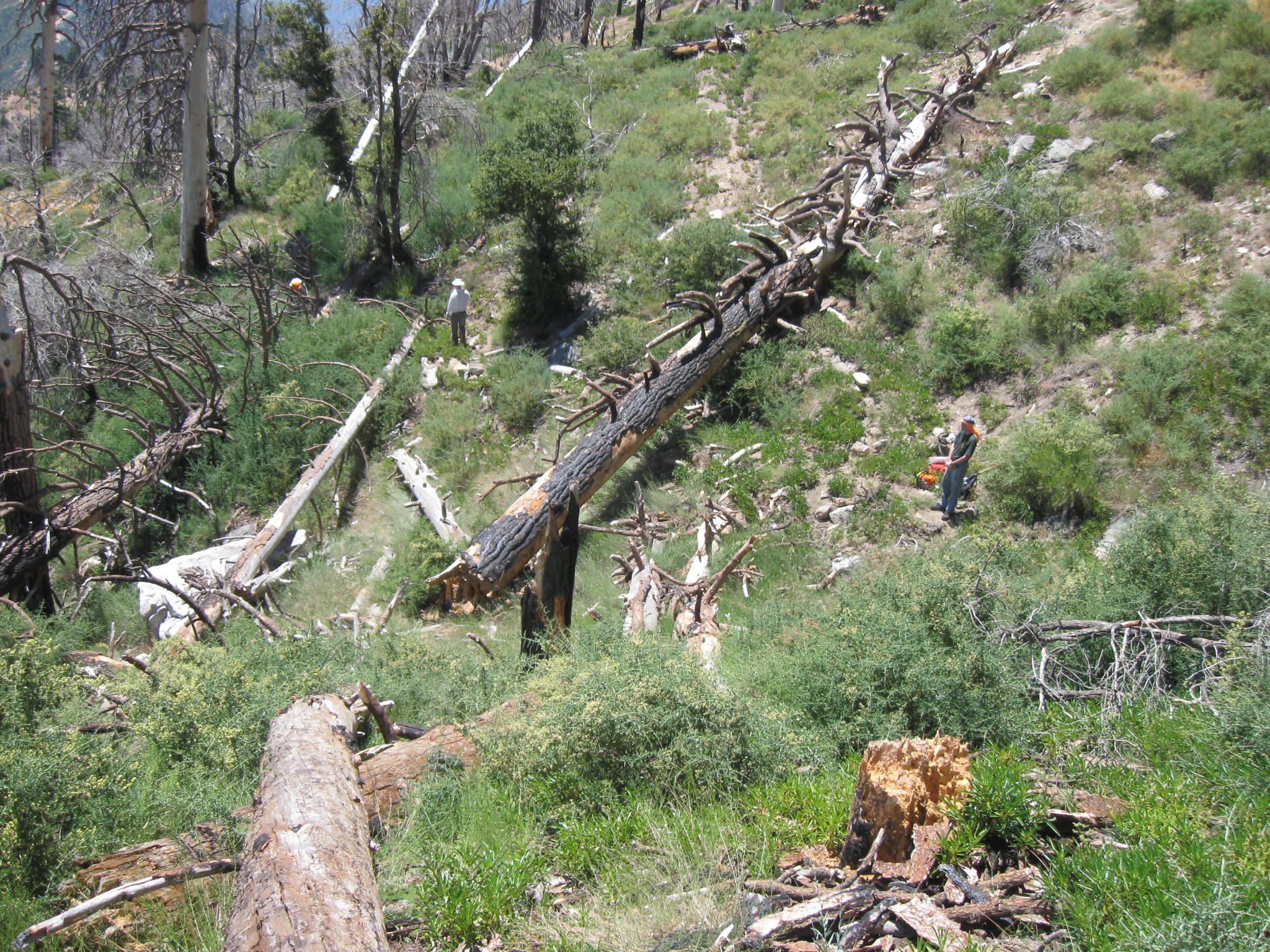 I climb the hillside to try to locate the rest of the trail
 After searching for a long time, Tom finds the trail right above us
 A very large tree that will need to be safely bucked and dropped
 Trailbuilders Mike and Ben watch Tom up on the ridge above us
 Mike cleared the ground under the next large bucking effort
 After the end of the chainsaw cutting, we again take inventory
 Dodder (Cuscuta epithymum) growing in clumps all over the San Gabriels
 Dodder stranling cianosis (spelling?)
 Hiking back down after the day's chainsaw effort
 Hiking back down after the day's chainsaw effort
 Hiking back down after the day's chainsaw effort
 Hiking back down after the day's chainsaw effort
 Hiking back down after the day's chainsaw effort
This web site is not operated or maintained by the US Forest Service, and
the USFS does not have any responsibility for the contents of any page
provided on the http://CrystalLake.Name/ web site. Also this web site is
not connected in any way with any of the volunteer organizations that are
mentioned in various web pages, including the
San Gabriel Mountains
Trailbuilders (SGMTBs) or the
Angeles Volunteers Association
(AVA.) This web site is privately owned and operated.
Please note that information on this web page may be inaccurate.