
28/Apr/07, UCC Dam Busting and Litter Removal
Photographs are provided in the links offered toward the end of this page.
Today in the Angeles National Forest about fifty or sixty young
volunteers from a variety of religious youth organizations (the UCC,
"United Church of Christ" and many other groups from all
around Southern California) gathered together with representatives of
the Sierra Club, the San Gabriel Mountains Trailbuilders, and the U. S.
Forest Service at the Rincon Fire Station in the San Gabriel River
Ranger District.
The volunteer effort consisted of breaking open a large number of
man-made rock dams across the San Gabriel River running along the
bottom of East Fork Road, and picking up and hauling away some of the
overwhelming amount of garbage and litter that lines the river and
surrounding countryside.
It was turning out to be a hot morning while the Trailbuilders
collected down below in the City of Azusa at eight in the morning
(Ben, Tom, and myself.) The day's plans also included working on the
Bear Creek Trail up around the 3200 foot mark just above Coldbrook
Campground however we eventually decided to hold off on that work
along that trail until we had some cooler weather. Since there's
very little shade up there, working with picks, shovels, and such in
the blazing Sun would have been rather difficult for anyone who wasn't
used to it so we put the kibosh on that part of the plan.
The Trailbuilders arrived at Rincon, met with the Forest Service, and
then waited for the other volunteers. A Sierra Club volunteer showed
up and then we waited for the big yellow school bus to arrive, staying
cool in the shade of the old oak trees, trading jokes and stories back
and forth, drinking tea and cola with ice, enjoying the occasional
cool breeze, comfortably singing the occasional Forest song -- while
the Forest Service people got to struggle up the canyon emptying trash
bins in the punishing heat.
When the bus arrived it was almost time for my lunch! Lois from the
Forest Service offered a brief safety meeting, suggesting that the
volunteers don't play with poison oak (she pointed out a stand of
poison oak growing in the yard) and suggested that we try to avoid
the Southern Pacific Rattle Snake that enjoy these mountains since
some times the snakes will bite when they're played with.
Earlier in the day I had hoped that I could pull up a plant and hand
it around, asking some of the young volunteers, "Do you know if
this is poison oak?" to see how many people would handle it
without thinking it through first. The Forest Service says that
poison oak is no joke, but I find it amusing! -- but only because I'm
almost entirely immune by now.
Lunch was sandwiches and chips. (I actually had two lunches, the one
I brought and the sandwiches that were brought.) After lunch some of
the more rambunctious volunteers paused to play basketball before
everyone climbed back on to the bus to head over to the work site.
This is the first time I'd ever been out along the East Fork Road past
the old Camp Follows area. The canyon road is usually very crowded
(which is why I avoid it) and today was no exception. We managed to
park the bus in a "no parking" zone (ha!) and the Forest
Service assembled everyone above the gate where plastic trash bags
were handed out and the group was divided in to two work groups.
The East Fork Fire Station is a place that I had never visited before
so I got a number of photographs of the place (which aren't posted
here on this web site but which are available upon request by Emailing
me.)
Ben and Tom joined the crew of other volunteers who started the day
picking up litter. Since Ben had lost a 1972 quarter somewhere along
the trail, he asked the volunteers if they would help him look for it
while they picked up trash. Ben has been looking for that lost
quarter for the past six years, to my recollection, and to his credit
he has never given up hope of reclaiming it.
Since it was a hot day I decided I'd join the dam busting part of the
effort first. We were supposed to trade off half-way through, trash
collectors swapping with dam busters so that everybody got an
opportunity to participate in both exercises. Since I was helping to
keep an eye on some of the younger volunteers down in the water, I
didn't help with the trash removal until near the very end when Lois
(USFS) and I carried up a heavy blanket that had been used to build a
rock dam -- must have weighed 200 pounds! (By the time we made it to
the Forest Service pickup, the blanket had some how grown to at least
300 ponds -- at least I was exhausted by the time we made it.)
Dam busting consists of getting into the river and taking rocks off
the top, flinging them to either bank or picking them up and
duck-walking them to the bank. Eventually water starts to flow
through the channel that's being built through the dam which carries
out mud, branches, and rotting leaves which then gives clearer access
to the next layer of rocks to be removed.
I had assumed that we would be removing the human-made dams entirely
since such dams allow ponds of water to accumulate which then get
warmer than normal which allows algae to grow -- which causes
problems for fish and other animals whose environment depends upon
cool, clear, flowing water, not warm standing water.
Humans build these dams for a number of reasons, primary among them
is their innate need to build and the innate desire to dam streams.
The desire is hard-wired into the human brain. The ponds of water
that collect behind them are used to wade and swim in and despite
the lack of any fish larger than an inch or so, people fish in such
ponds.
With rock dams, the
Santa Ana
Sucker (that's a fish!) can't have an easy time of swimming down
stream from the river and its various side creeks down to the basins,
restaurants, bowling alleys, and other places where such fish like to
go.
So why not bust up the entire dam rather than open one or two channels
in them like Lois asked us to do? It seems that the Santa Ana Sucker
was fairly recently placed on the Endangered Species List and as such
some of the warmer standing water ponds that have resulted from years
of human dam building have to be left in place. We build channels
through them so that fish can migrate, but we must leave deeper,
cooler pools for the small fish to live in as well.
If I had a guess, the more difficult effort wasn't the hauling of
heavy rocks from the cool of the river but the hauling of the litter
from the heat of the rocky river bed. In cool or wet weather I'll
volunteer to pick up trash, but in the heat of the day I'd rather
swing a pick-mattox and use a shovel. Down in the river I could
dunk my old leather cowboy hat into the river, fill it up, and then
dump the whole thing back on top to quickly cool off. In the rocky
riverbed on either side of the river, it looked like hot, sweaty work.
Toward the end of the day the trash bags were collected up and hauled
to Mike's Forest Service pickup truck. I walked along the banks of
the river for a bit trying to make sure that everyone in the group
who were supposed to leave wasn't being left behind -- and I found
a frog hunter in the group lagging behind still searching (I asked
him if he didn't get enough lunch. The kid maybe didn't see how I
was trying to make a joke since I've heard that Crunchy Frog is
quite delicious. Come on! You know: Crunchy Frog? Monty Python's
Flying Circus? I hate Spam? Anyway... Where was I? Oh, yeah...
Dam busting.)
Back up at the parking lot, the youth organization volunteers returned
to their bus, the Trailbuilders returned to their pickup trucks, the
Sierra Clubber returned to her nest, and both Mike and Wes of the U.
S. Forest Service was left alone to pick through the mountain of trash
that had been collected, sorting through the trash for recyclables
-- maybe the more difficult and disgusting job of the day.
Did I mention how enjoyable I found the day to be? Any opportunity
to get out of the city and in to the mountains is a good day, and
any excuse to play in the river and exercise is a big plus. But
having so many young kids come out to do something of immense
benefit for our National Forests and the water-borne creatures who
live there is beyond description. I greatly appreciate their efforts
and I hope that some will harbor as great and as deep a respect for
Mother Nature and all her creatures as much as I do.
A good time was had by all, even those who accidentally fell over
backwards (actually they were pushed!) into the cold river. Ha!


 The bus comes with most of today's volunteers
 Gathering before the safety meeting
 A wider look at the gathering prior to the morning's safety meeting
 Lois (USFS) give the safety meeting
 A cution about handleing poison oak
 And a caution about putting one's hands in among rattle snakes
 The other side of the safety meeting
 Lunch is being set out on a card table
 And lunch is served! We have a nice shaded table area also
 Some of us pause for a bit of basketball while we wait
 A bridge on the way along East Fork Road to the work site
 We get to the East Fork Fire Station. Note how crowded the area is
 I catch Lois in her pickup truck. "Behave!" I always do
 At the work site, getting organized a bit more
 A view along the trail to the canyon's floor
 A gaggle of dam-busting volunteers spread out along the river
 A first look at one of the dams that needs to be broken up
 This rock dam is considered busted enough to go to the next dam
 Lifting boulders out of the streams
 And another photograph of a dam that's been freshly opened / busted
 The goal is to open up rock dams wide enough for fish to travel
 Another dam gets broken up. I take before and after photographs
 The difficult, hot, sweaty work of litter removal also takes place
 Shifting rocks, don't mind the camera guy who isn't working hard
 There are some nice trees to rest under along the river
 Each dam takes anywhere from five minutes to maybe fifteen minutes
 Some dams start with fallen trees which are harder work to remove
 A channel on the left is now flowing; I ask for another channel on the right
 Interlocked down trees make dam removal even more difficult
 Some heave a pinned log while others watch to see if it will move
 This particular log jam isn't coming apart easilly
 A thumbs-up for the effort so far
 Pausing to rest while draging out two bags of garbage
 Getting to be toward the end of the day's volunteer efforts
 Tom and other volunteers gathering toward the end of the day
 Volunteers returning.
 More volunteers. I'll try to get as many volunteers on camera as possible
 Hey, everyone, we're packing up! Time to call it a day
 More volunteers returning from the river
 A look South at some of what was accomplished today
 A look North and a glimpse at people who utilize this area for recreation
 Another nice tree along the river to rest under in the shade
 The bus and the rally point off in the distance
 Hunting for frogs in the San Gabriel River
 Almost everyone else has made it to the Forest Service pickup truck
 Mike (USFS) gets on the radio, keeps track of what's happening in the forest
 Some volunteers after the day's work. Nobody seems to be too exhausted
 Kid getting ready to hit Ben in the back with a rock! Look out, Ben!
 Some more volunteers
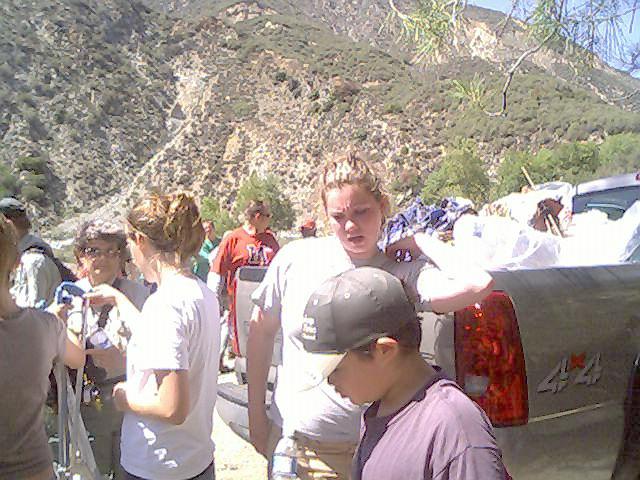 And some more volunteers. We're almost done for the day
 Milling around waiting to hike back up to the parking lot
 One final picture and my camera is full: Some of the trash that was collected
This web site is not operated or maintained by the US Forest Service, and
the USFS does not have any responsibility for the contents of any page
provided on the http://CrystalLake.Name/ web site. Also this web site is
not connected in any way with any of the volunteer organizations that are
mentioned in various web pages, including the
San Gabriel Mountains
Trailbuilders (SGMTBs) or the
Angeles Volunteers Association
(AVA.) This web site is privately owned and operated.
Please note that information on this web page may be inaccurate.