
Today the San Gabriel Mountains Trailbuilders got together with a large
number of young volunteers to work on adding rock stair steps to a section
of the East Fork Trail, a trail that starts at Heaton Flats, follows the
San Gabriel River, and goes past the infamous Bridge To No Where.
And what fun it was, too! Being March, the day wasn't hot, allowing an easy
hike in to the work site despite being loaded down with tools and equipment,
and an equally easy hike back out once the day's volunteer work had been
accomplished. Being at only around 2,000 feet altitude, it can get very hot
along East Fork even at night, but today the weather was perfect!
The volunteers met at the United States Forest Service Gateway Information
Visitor Center at the bottom of the mountain, the building next to the large
water tank at the bottom of Highway 39 across from mile post 17, where we
traded lies and jokes until it was time to get to work.
When 8:00 came, everyone sorted out their various rides and we all drove
North to the Rincon Fire Station to collect our tools and equipment for the
day, got back in to our vehicles and headed East along East Fork Road,
turned left at the Glendora Mountain Road junction, and on to the end, all
the way to Heaton Flats.
Because we would be working in a fairly deep canyon, I called in to our
Dispatch Overlords over the radio to let them know how many volunteers would
be working on the day's effort and approximately where we would be located,
that way we would be kept informed about any significant issues that might
crop up during the day (such as lightening, fires, floods, whatever might
happen.)
It was a fairly large group of volunteers who came today, with Scouts and
College students mixed in to lend a hand continuing the extensive trail
maintenance work that the Trailbuilders have been coordinating for the past
two years.
A great deal of trail work had already been accomplished on the first five
miles or so of the trail, and all of the hazardous rock faces have been
tamed, narrow ledges widened, and generally the whole trail made less
hazardous. Today's effort addressed another rock face which would be
turned in to a slope with stone steps, and while that took place, some
additional tread work was done.
Ben gave the day's safety meeting, covering each of the tools that would
be used to ensure that volunteers who used such tools would do so safely.
In addition he covered the local flora and fauna, pointing out hazards such
as rattle snakes, poison oak, and ways to mitigate against getting bitten,
stung, scratched, or poisoned.
This safety meeting at the beginning of each volunteer day is something
that's done regardless of who comes out to volunteer, whether they have
been doing such work for decades or whether it's people's first time. It'
s a good way to get one's mind focused on the first priority: Safety.
Volunteers don't do anything they feel uncomfortable doing, and the safety
meeting is one way to examine the tools and equipment and see what one
might like to use and see what one doesn't feel comfortable using.
It's also easy to get complacent and to forget to wear gloves or forget
to look first where one's going to sit. A safety meeting every time covers
job hazards, tool usage, medical issues, anything that might come up
during the day including how to safely step off the trail to visit the
toilet and not disappear forever.
In order to get to the work site we needed to cross the river twice (and
twice more on the return trip) and each crossing required steady feet and
some serious concentration on where one sets one's feet since the river is
running high and fast now thanks to the heavy rains and snow melt that
Southern California enjoyed recently.
The river crossings were awesome! I had a safety rope on myself just
because I tend to like bringing a rope on these things since there have
been times when we've needed one (often to pull down a hanging tree hazard)
so I spent some time centered in the river with Trailbuilder Tom and handing
tools along. I had found good solid footing next to Tom and we passed tools
across so that volunteers could concentrate more on crossing.
It's an adventure! Some of the younger volunteers did not seem to want to
cross since that much rushing water isn't something one crosses every day.
There is a significant though minor safety risk involved in crossing water
that's even ankle deep, and though crossing the river like today wasn't
exactly hazardous, it's still frightening if it's the first time. New
experiences are often worrisome.
Courage is being afraid and doing it anyway.
There was one kid who was very afraid yet he got on with it, carried his
long trail-working tool safely across the rushing river right behind everyone
else, only breaking in to sobs once he was on the far side after it was over.
Courage! Inwardly I cheered.
At the next river crossing everyone made it across without even a whimper,
and I would love to hope that for everyone who had forged the high-running
river for the first time today and were afraid, they'll remember today and
remember how they did something adventurous despite being afraid.
At the site where the steps were to be established, a grip hoist was used
with long steel cables to drag boulders in to place while volunteers worked
on seating them solidly, filling in the region with sand, gravel, rocks,
and dirt carried in buckets. Because the hoist cable carries tension, safety
people were positioned on both sides of the trail to stall hikers while
boulders were being moved.
While working at the site, our Dispatch Overlords called me on the radio
to ask if I was in the area which was something of a surprise since it's
pretty rare for our Overlords to check on us volunteers during the day. We
monitor a radio to keep informed about changes in the weather, lightening
strikes, fires, a lot of things that go on in the forest we're kept informed
about as a safety measure, and it's rare to be called by Dispatch.
What I was told was that there were two hikers overdue, young kids who had
taken the hike to the Bridge To No Where and were overdue enough that a
parent was worried enough to contact local authorities and get a preliminary
search effort underway. The first step was to see if anyone was in the region
who could search while maintaining radio contact, and the Trailbuilders had
been reported as being in the area so we got called.
Just by coincidence I happened to remember giving the two hikers information
on how much further the Bridge was earlier in the day, so Dispatch handed me
off to the guy starting the preliminary search effort who asked my son and I
to attempt to locate the hikers. It took a while before we got a physical
description of clothing and such but eventually we worked it out.
We hiked East and managed to find the hikers and informed the building
search effort that the hikers were on their way out and could be expected
to reach the trailhead in about half an hour (assuming 4 miles an hour
walking speeds.) We made sure that the overdue hikers made it to the
trailhead where-after we dumped our equipment and tools at the trailhead,
found some shade, and called it a day -- though all the other volunteers
continued to work on the trail.
A whole lot of work got done at the work site though I only managed to see
perhaps the first half of it. Comments by hikers who passed through where
my son and I were resting told us that they had looked over the day's effort
and were impressed, many have wondered how huge boulders get moved and when
the grip hoist was not in use the volunteers showed them the equipment and
told them what it does and how it works, I was told.
Eventually all of the volunteers started trickling back to the trailhead,
bringing their tools and equipment back with them, dumping them on the
ground, and either looking for water else finding shade to relax in until
everyone was back.
It took a long time for everyone to return -- something like 90 minutes --
but eventually we packed up the vehicles and returned to Rincon where the
tools and equipment were inspected and stored properly back where they
belong.
After the noise, excitement, and exhaustion of the day is over and the
many volunteers have driven away, the long-time Trailbuilders often pause
to talk about how things went during the day, what worked, what went wrong,
and talk about any amusing things they saw or overheard.
I mentioned that it was a feather in the Trailbuilder's cap to be asked to
find overdue hikers and then to actually locate them which begged the
question about how many hours a High School-age kid would have to be overdue
on a hike before a parent should become legitimately concerned.
I remember being that age and disappearing for months at a time, not
attending school or returning home but rather living on Newport Beach or
in the Mojave Desert, and my parents never worried about it. But then I've
always been a wild, uncontrollable, dirt-encrusted savage who has changed
very little in the past 40 years so I'm really not surprised.
We finished up at the Fire Station, got in to our vehicles, and returned
to the cities far below, our backs and legs pretty sore but it was terrific
fun!


 At the Rincon Fire Stating getting tools and equipment
 At the Rincon Fire Stating getting tools and equipment
 At Heaton Flats staging the tools and equipment before the safety meeting
 We check through the back packs
 One of the volunteers workong on the stair steps today
 Ben starts going through the tools and equipment that will be used today
 The hike in to the work site
 The first river crossing. Adventure!
 The other side of the second river crossing
 At the work site the trail tools and staged and we get our first look
 One end of the grip hoist is attached to a very large boulder
 The steel cable is laid along the edge of the river
 The grip hoist gets set to move a large boulder
 Here you can see some of the large boulders that have been moved already
 Trailbuilder Lou pauses at the end of the day for a photograph
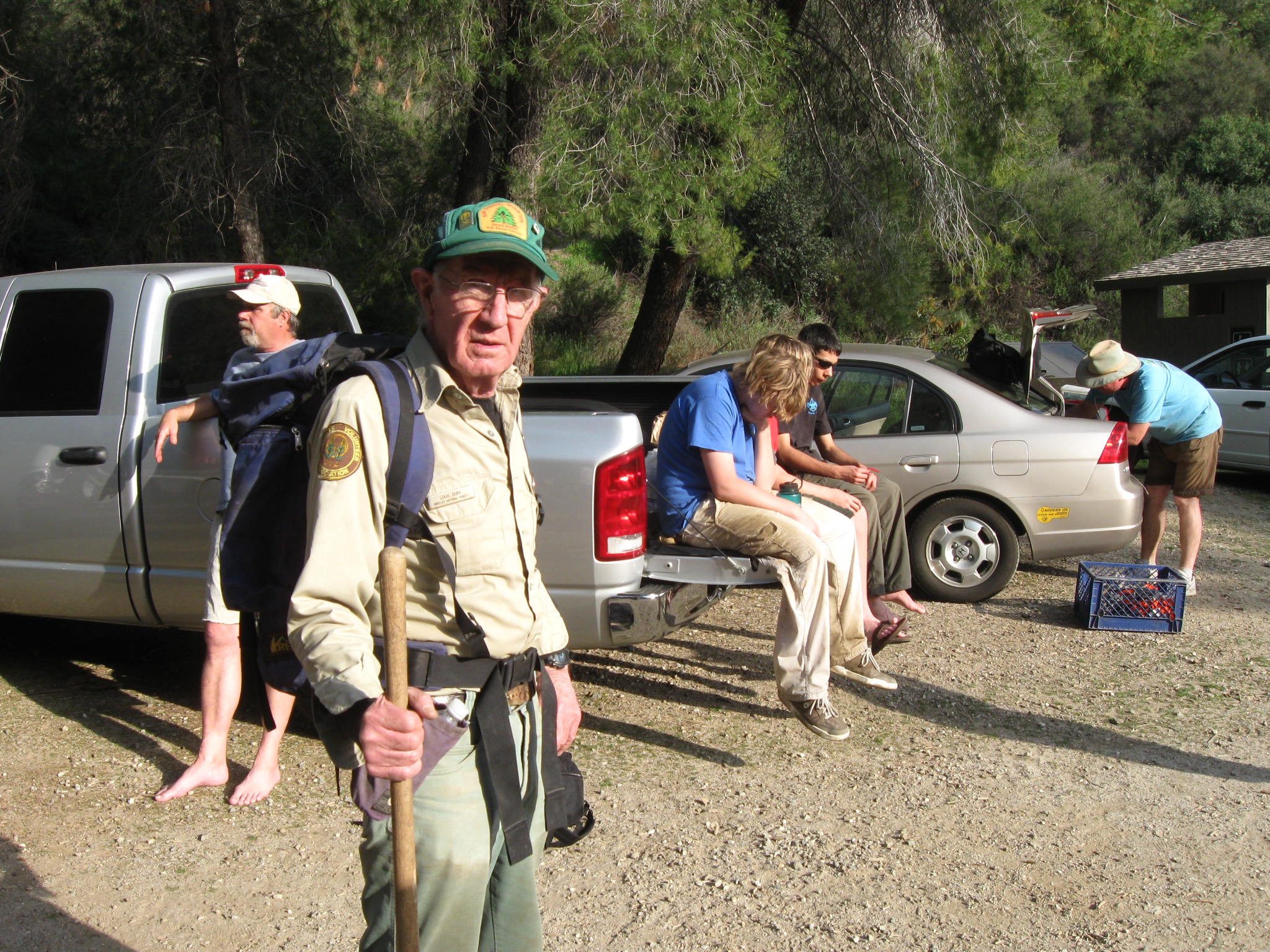 Another good look at Trailbuilder Lou
 Trailbuilder Fred also gets his photograph taken
 Trailbuilder Bryan removes the heavy cargo pack with the grip hoist in it
 Removing the grip hoist cargo pack isn't always easy!
 Trailbuilder Tom gets his photograph taken
 Another good look at Trailbuilder Tom
 And yet another look at Trailbuilder Tom!
 And finally, a look at Trailbuilder Ben
This web site is not operated or maintained by the US Forest Service, and
the USFS does not have any responsibility for the contents of any page
provided on the http://CrystalLake.Name/ web site. Also this web site is
not connected in any way with any of the volunteer organizations that are
mentioned in various web pages, including the
San Gabriel Mountains
Trailbuilders (SGMTBs) or the
Angeles Volunteers Association
(AVA.) This web site is privately owned and operated.
Please note that information on this web page may be inaccurate.