
The River Not Forgotten and Eagle Candidate Jack Team Up
Today is May 19th, and it's another glorious sun-filled day to
volunteer to work hard in the
Angeles National Forest,
working to improve the health of our Forest environment and the quality
of the water that we drink down in the cities below.
Jack's Eagle Scout Project and Amelia Everett's Community Project
came together and worked perfectly together in the
San Gabriel River Ranger District
along the
East
Fork Road of the Angeles National Forest. The final results:
Something like 20 illegal rock dams were busted open to allow fish
like the Santa
Ana Sucker to move freely along the river, three illegal access
trailed were blocked and filled in with rocks, and 32 large bags of
garbage were collected and hauled out of the riverbed -- a good day's
work for some 30 young volunteers.
The day started out early for me -- up at five in the morning
to get my bicycle repaired enough to get me to the Ranger's
Office on time. Amelia -- a local
High School student -- and
Lois (USFS) were waiting for me at the Forest Service District
Office and by the time I parked my freshly-repaired bicycle and
walked in to the Office (ten minutes early by my reckoning) the
two were grabbing their stuff, ready to head up the mountain to
Rincon
Station.
Most of the other volunteers met us at the Rincon Fire Station
along the North Fork of the San Gabriel Highway (also known as
Highway 39) which heads North from the City of
Azusa,
California, up to
Crystal Lake
and then
Angeles
Crest Highway (Highway 2.)
The Ranger Station there is a neat little building about 11 miles
up into the mountains across the highway from the Environmental
Education Center (which hosts many thousands of young students
for a variety of educational events every year.)
While Amelia's group of volunteers were going over safety issues
with Lois and covering what the effort would be for the day, I
waited for members of the
San Gabriel Mountains
Trailbuilders who also had a day of trail building scheduled
for the day. To be sure it was a bit of an unusual morning for
me since -- despite my stupid yapping mouth -- while waiting for
Ben to show up I managed to avoided getting my lip deservedly split
open by a friend.
During the safety discussion Jack and his
Eagle Project volunteers
arrived and joined in on the safety meeting. When the meeting was
about done many volunteers went to examine the
poison oak
growing in the Station's yard and I once again thoughtfully suggested
that they pick it up and pass it around so that they'll know what it
looks like so they can avoid it ("Poison Oak: It's No Joke" --
but I still find it funny! Maybe because I'm nearly immune to
the stuff by now.)
From Rincon Station we piled in to a few vehicles (there were
about 30 of us) and we drove to the work site. The area we were
to work on is a two-mile stretch of river East of
Camp Williams
along the East Fork Road, and though it's not the most heavily
trashed area of the river this section has a great many illegal
rock dams as well as a disturbing amount of litter and garbage --
this despite the never-ending work that the
Forest
Service does cleaning up countless miles of road and river
out here.
An
"easy up"®
was easily installed to provide a bit of shade for
the cold water station along the road and then work began.
The "coyote trails" that are used to gain access to the river
from the road are often dangerous and always illegal. They're
created by people who don't wish to take the time to walk to
the official trails that lead down to the river. These trails
cause erosion and safety hazards that can result in medical
calls that the fire crews in these mountains have to respond
to so some effort is made to fill in or block these trails.
The rock dams cause their own set of problems, not the least
of which is that when water pools up behind them that raises
the temperature of the water which allows
algae to grow
which -- if it grows too much -- chokes off the other life in
the pool. In addition to the water getting too warm, these rock
dams trap fish -- which includes the endangered
Santa Ana Sucker
-- behind them, blocking off their progress down stream and
reducing the genetic diversity among the species.
And of course the pollution caused by people who love to dump
their garbage on the ground after a day of picnicking, camping,
or smoking crack cocaine and whatnot along the riverbed is
another major problem. Some sections of the river are clean
and look good since they've had volunteers come clean them up
in the past six months or so while other sections of the
river are truly disgusting since the wind conspires to collect
garbage in them.
Since dam busting is fun and the water is cool, I joined the
dam busting effort after helping to drag logs out of the river
and up to the coyote trail blocking effort (I actually do work
at these efforts; I don't just stand there with a camera taking
it easy and sipping cold diet cola during the day, honest I
don't. Well mostly I don't.)
One particular circle of rocks needed attention: Fish living
in a small circle of water could not leave the pool. Jack
gathered three or four volunteers and we opened a channel for
water to enter the pool and another channel was opened to
allow the fish to leave. Some of the volunteers picked out
rocks and examined them for fish eggs before either discarding
them on the bank or setting them gently back in to the water.
When we were done, the circle of water looked great: Cold water
and other fish could enter while at the same time the fish that
had been trapped in there and the fish who would later hatch
from the eggs could now leave the small pool.
Lois continued to work with the general visitor public from time to
time since people would come up and ask questions for a variety of
things. I got to talk with a guy who was there in his tent with another
individual and he told me that from time to time he helps collect garbage
in along the river since he spends a fair amount of time in the area.
One thing that we're often asked is when the next litter removal
project is by people who wish to volunteer. Lois suggested that
people call her
District Office -- which is a good idea. I think
that I should start putting proposed schedules up on this web site
as well so that people can find the dates and times for future
trash removal and dam busting projects.
The larger number of volunteers working on the trash pick up
concentrated their efforts along the water and then they
started encompassing the whole riverbed from canyon wall to
canyon wall, collecting trash in to their plastic bags.
It was great watching so many young kids doing hard work to
help their environment. Lois noted aloud that these National
Forests belong to all of the people and that the water that
flows from these rivers and side canyons up here comprise about
80 percent of the drinking water we enjoy down below.
Having High School students come up to do hard -- but fun! --
work in these mountains renewed my hope that the future of
America has at least some good hands to carry the nation onwards.
I could wish that everyone cared enough for the environment and
their National Forests to do so much, but I'm glad that there's
at least some who do (after all, us older volunteers won't last
forever -- at least our poor old, pained backs won't last much
longer!)
I told a number of volunteers that they got to keep whatever
they found since there was a lot of valuable garbage here: dozens
of old shoes, two dozens of old socks, plastic bags by the arm
full, somebody's bra, someone else's shirt and underwear,
hundreds of broken beer bottles, nameless lumps of plastic
and
polystyrine,
a small fortune in recyclable beer cans,
disgusting wads of shit-encrusted toilet paper, gelatinous,
quivering piles of rotting who-knows-what by the bucketful...
Two miles of garbage was dragged out of the riverbed (If anyone
found Ben's lost 1971 quarter, they never told me about it.)
A group of volunteers dragged out a soaked canvas tarp, it
looked like, which must have weighed about sixy pounds. These
heavy bags of trash were tied to a rope and then hauled up the
canyon wall to the road above where Alan and a number of other
volunteers waited to collect the bagged garbage for later
pick up.
I found a television antenna that goes on top of a house; an
antenna that looked to me to be in perfectly working condition,
coming with its own cable which also looked in perfect condition.
It was a bit rusted but it looked like it would still work.
We tossed that puppy on to the trash also but only after Lois
picked it up, held it above her, and told me she was picking
up the
BBC in London
or something -- I was laughing too hard
to hear exactly what she said about who she was picking up on
the old antenna.
Toward the end of the day we concentrated on litter removal.
Alan met me at the top of the canyon wall along East Fork and
put a trash bag in one of my hands and a "picker" in the other
hand and suggested that I give trash picking up a try.
I don't like picking up litter unless I can be reasonably
assured that I'll also find money that someone has lost in
among the usual cigarette butts, beer bottles, used toilet
paper, used condoms, plastic bags, and other garbage one usually
finds along any road in
Los
Angeles County.
The "easy up" was taken down (just as easily) and packed away,
then Amelia, Lois, and I said "good bye" to the few remaining
volunteers who had not already left and then we got in to our
own vehicle and headed for Rincon Station to borrow a large
truck so that we could come back and pick up the bags of litter
that had been accumulated.
It didn't take long to hunt up the keys to the largest flat bed
panel truck that we could find and then we crammed in to the
front seat and drove back to the work site. Some of us counted
32 bags of trash, others counted 34. What was sure was that we
got a good haul of garbage out of the riverbed and that's a
good day's work for Jack's Eagle Scout Project and Amelia's
River Not Forgotten -- something both of them should be proud
of since it was good stuff.
We were all exhausted by the time we got back to the District
Office, what was left of me climbed back on to my bicycle, Lois
and Amelia remained to finish whatever paperwork was left for
the day. I rolled wobbly down the street toward the closest
Del Taco®,
limped to the counter, asked for a burrito and a
gallon of
Diet Coke®,
then passed out while waiting for my order to arrive.


 Some shade is set up with a table and sold water for the volunteers
 A wider view of the East Fork Road clean-up / dam busting project
 The people in the tent on the left also pick up trash at times -- Thanks!!!
 An illegal "coyote trail" that will be filled in, blocked off
 Another look at a coyote trail that will be blocked off
 Most coyote trails are dangerous, some are not. Most need to be blocked
 Volunteers set up a line to transfer rocks and boulders from the riverbed
 Illegally dredging outside of allowed areas -- Wait 'till Lois sees theses guys!
 One of the first rock dams of the morning to be bucted open so far
 A closer look at the channel opened in the rock dam -- good for fish
 This rock ring has Santa Ana Sucker fish in it -- must break this open
 Coyote trail being filled in and/or blocked off
 Another look at a blocked off coyote trail from highway down to riverbed
 Another coyote trail that's been blocked off
 I will return in two months to see if these coyote trails are still blocked
 Another blocked trail. A lot of hard work goes in to moving rocks, brush
 Rock dam busting around illegal dredgers draws angry comments from dredgers
 Soe dams required ropes to remove the tree branches that were used
 Start at the top and work down to the bottom -- rock busting made simple
 Litter clean up taking place while rock dam busting goes on
 The number of illegal rock dams is amazing -- as is the amount of litter
 This rock dam is opened enough for fish to travel through it
 Some ponds will drain, others are left pretty much intact
 Jack (Eagle candidate) usually decided where channels should be opened
 More than one channel is opened in this particular rock dam
 Gives a good view of what the riverbed is geneally like along East Fork
 Along long look at the riverbed, Amelia with litter removal effort in distance
 This rock dam will get at least three channels opened in it
 Soe dams are built to create pools which heats the water and kills the fish
 A difficult rock dam: This one will requite ropes for the last log remaining
 Litter removal effort combine with dam busting -- going to strand this guy!
 A wide look at the work effort near this rock dam
 The volunteers work out a plan and dig out rocks, mud for the last log
 A bunch of volunteers drag the last log out of the dam and on to the shore
 Litter removal and an opportunity to cool off in the river
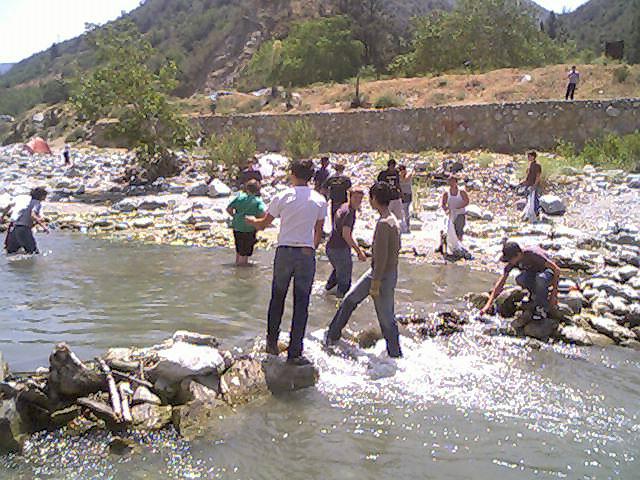 The work continues -- I think that's Alan up on the road taking full trash bags
 Taking a break from picking up litter to swim in the river -- what fun!
 Work continues -- getting to be about time for my lunch
 This rock dam is just about opened up enough
 A look back
 And a look forward. Here's where I fell in, holding my camera up high
 Another 200 feet, another rock dam to be busted open
 I leave rock busting and I join in on litter removal
 Full and heavy trash bags are tied to a rope and hauled up to the road
 Taking a picture of this tree with Fox in the foreground
 From up on East Fork Road, here's what one of the dams looks like now
 Another look down to the riverbed from along the East Fork
 And another look showing another opened rock dam
 Way off in the distance litter removal and pink little girl still swimming
 Three rock dams opened up as seen from the East Fork
 Most of the effort now is litter removal but a few more rock dams are opened
 I like rock dam busting since it's cool water and it's fun!
 Liter removal is hot and sweaty work but it's also satisfying work
 There are more dams to be opened than we have time to do it in
 Litter removal greatly improves the general health and quality of the water
 Some of the trash collected so far -- we'll come by later to collect it
 We are almost done so the shade and water station is disassembled
 Amelia Everett, Lois P. (USFS) and I return to collect the bagged garbage
 I'm amazed at how much garbage we got out in about six hours or so
 A final look at the litter that was removed
This web site is not operated or maintained by the US Forest Service, and
the USFS does not have any responsibility for the contents of any page
provided on the http://CrystalLake.Name/ web site. Also this web site is
not connected in any way with any of the volunteer organizations that are
mentioned in various web pages, including the
San Gabriel Mountains
Trailbuilders (SGMTBs) or the
Angeles Volunteers Association
(AVA.) This web site is privately owned and operated.
Please note that information on this web page may be inaccurate.