
Usually my mornings begin with Zorro The Cat stepping on my face and
demanding, "Me-yowl?" (which is Zorro's word for
"breakfast") however this particular morning was a volunteer
day with the San Gabriel Mountains Trailbuilders so for once I was up
before the cat, shoving things in to my new mouse-chewed backpack and
slipping out of the house before anybody knew I was gone.
This particular Saturday morning would mark my return to the volunteer
effort after a seven-month hiatus during which I worked on my tan, biked
up and down the mountain a lot, crashed a few times and acquired some
awesome new scars, and fed the cats generally on time every morning.
Ben rolled up in his new (and as yet uncrashed) pickup truck and together
we drove through the city to the Gateway Information Center at the bottom
of the mountain overlooking the City of Azusa. The Gateway Center is
located along Highway 39 (a.k.a. Azusa Boulevard a.k.a. San Gabriel Canyon
Road a.k.a. a whole lot of other names) across from mile post 17.00, a
wonderful new U. S. Forest Service building which contains a unique artistic
rock wall and is surrounded by equally unique rock-and-basket fences.
Bernie from the Trailbuilders was already there waiting, and while other
volunteers accumulated I stayed in the warmth of the pickup truck reading
(in the dark, no less) through the user manual on some new safety equipment
the Trailbuilders had recently acquired, intrinsically safe radios that
would allow groups of workers buried deep along the trails in canyons and
ridges to stay in contact with each other as well as allowing emergency
access to our radio Dispatch Overlords.
Safety has always been the top priority with the Trailbuilders, it's one
of the reasons why they're so successful and one of the reasons why their
safety record is nearly perfect. The new equipment adds another layer of
safety back-up to the existing safety procedures, clothing, and equipment
the Trailbuilders employ, and since this is the Angeles National Forest,
anything can happen so added safety is always nice to have just in case.
The radios even have an S.O.S. mode which broadcast the radio's position
when activated, even if an operator slips in to unconsciousness or is being
dragged off in to the wilderness by her arm by a bear. Awesome technology,
coupled to the Geosynchronous Positioning Satellite system means we now have
first-eyes report capability on fires, avalanches, and medical emergencies,
but we also now have the means to stay in touch when we break up in to
groups.
At least that should be the case once the equipment actually arrives, then
we will see just how well it works in the field. While reading the user
manual I saw that Trailbuilder Alan would be joining the effort today, a
break from the litter collection volunteering that he performs along the
highway every day.
Around 7:00 O'clock most of the volunteers loaded up their vehicles and
started heading North, up towards East Fork Road. Since Bron from the
Trailbuilders already had the trail working tools and equipment that would
be needed for the day's effort, the volunteers did not need to go to the
Rincon Fire Station to collect the tools, and that saved us about one hour
of stage-up time that would normally have been needed, giving us an
additional hour of shovels-on-the-ground time.
Jeanette from the Trailbuilders stayed at the Gateway Center to coordinate
and collect the late-comers who would be volunteering today, and once 8:00
O'clock arrived, she and the other volunteers gathered below also headed
North toward East Fork Road and to Heaton Flats, the trail-head closest to
where the volunteers would be working today.
At Heaton Flats a safety run-down was stepped trough along with some final
instructions offered by the Eagle Scout candidate who would be coordinating
much of the trail building effort. Breakfast was then offered, and when I
approached the card tables that had been set up I couldn't help but ask the
adult volunteer "me-yowl?" like Zorro always does at breakfast
time. Since I got a confused look, I translated to English, asking if
there was any enchiladas with avocado. There wasn't so I grabbed the next
best thing, bagels, fruit, and orange juice.
Bron and the Eagle candidate had already gone on ahead so after grabbing a
few more things from the card table and shoving them in to my pack, I hiked
off to see what the work site looked like.
The work site was a mostly smooth granite outcrop over which people must hike
to avoid wading through the river on the way to the infamous "Bridge To
No Where" about 4 miles or so further down the trail. Laurel Gulch
and the John Seales Bridge project that the Trailbuilders coordinated is
about one mile further from the outcrop of rock that would be worked on
today.
It's always irritating to see other people crapping-up the outdoors, either
when they drop litter on the ground, spray paint rocks and trees, or commit
illegal mining in the river. In an act that makes me very angry, four miners
started to resume digging up the far embankment right across from the trail
maintenance work site, digging a deep ditch in to the embankment after asking
me if I was a Ranger, knowing that what they were doing is illegal and
wondering if they had been caught.
As of last year, all dredge and sluice-box mining has been banned with less
destructive gold panning still permitted. The devastation of literally
thousands of people mining every year is horrible, ugly, and unsightly, as
is the untreated biological waste that floats down river. Three or four
grain specks of gold can be acquired after washing out five or six hundred
pounds of dirt, and while that translates to a thousandths of a penny per
hour worked, the unsightly ecological damage is profound and lasts for decades.
When most of the volunteers had arrived on site, the Eagle candidate went
through his printed lists, assigning people to specific tasks which included
safety monitoring, boulder retrieval, rock collection, gravel and dirt
collection, drinking water dispersement during the day, and the variety
of jobs that would be performed. Additionally another run-down on safety
was offered with the identification of qualified First Aid people with
medical kits.
The next three hours saw lots of boulders extracted from hillsides, along
the river bank, and along the trail, boulders that were dragged, rolled, or
carried to a staging point near the large granite outcrop that would form one
of the two primary work points. While that was going on, thousands of
bucket-fulls of rock, gravel, sand and dirt was dug up from a slope, carried
by brigade down the trail, and dumped in sections to smooth out the trail
along the river.
At the granite outcrop, Trailbuilders Wayne and Tom at times used chisels
and hammers to remove some of the more obvious stumbling points along the
top of the outcrop while on both sides of the outcrop boulders and rocks
were dragged in to place, fit together, and then cemented in to place with
gravel.
Lunch was provided by adult volunteers who had on hand a number of different
sandwiches as well as the makings for sandwiches if one of the pre-made ones
was not to one's liking. I looked for enchiladas again, asked
"me-yowl?" and then grabbed bread and things and slapped something
together, grabbed some cookies, potato chips, and orange, then grabbed some
more cookies when it looked like nobody was looking (in all I got eight of
them! I would have grabbed the whole container then gone off somewhere
and quietly eat them by myself but that might possibly have been rude.)
After lunch work continued at the same pace as before, maybe even stepped up
to some degree. The bucket brigade split in half, the slope we were pulling
rock and dirt from getting fed in to buckets which went both up and down the
trail, material being used to fill in the West slope up against the granite
outcrop, and material being used to add rocks and gravel to the trail along
the river.
Eventually the bucket brigade split in to two, the section that had been
working against the granite being asked to climb over and form the brigade
again on the other side. Material was collected on that side to fill in the
gaps between the huge boulders that had been painstakingly fitted in to a
jigsaw of shelves that afforded a stairway which now allows hikers to step
easily up, across, over, and down the granite outcrop.
While that was going on, the other half of the bucket brigade continued to
work the original slope of material, filling, hauling, and dumping thousands
of pounds of rock, gravel, sand, and dirt to fill in the depressions along
the trail that followed the river.
Today worked out well, all of the tasks for the projects which took place
were completed successfully, and there were no injuries, plenty of drinking
water, and everyone had a good time out in the forest.
Today's effort was another weekend in an on-going series of projects designed
to greatly improve the East Fork Hiking Trail all the way from Heaton Flats
toward the "Bridge To No Where." The San Gabriel Mountains
Trailbuilders provide the coordination, tools, equipment, knowledge,
experience, safety oversight, and shovels-on-the-ground work, relying upon
youth groups, college students, hiking groups, and other groups to provide
willing volunteers, materials, instruction on the projects, and additional
safety oversight.
For a number of years East Fork Trail had been set as a lower priority than
other trails in the San Gabriel River Ranger District of the Angeles National
Forest since there are a great many well-loved trails and only so many
weekends in a year where volunteer work can be performed. Today's volunteer
effort is one of many that have been performed on East Fork which improves
hiker safety while still leaving a rugged hiking experience.
At the end of the day when everything had been accomplished, the equipment
was packed up in to the cargo carrying backpacks, tools were collected, one
last look around was performed to make sure we did not leave any tools or Boy
Scouts behind, and then almost everyone started heading toward Heaton Flats.
I shouldered one of the grip-hoist tools in a heavily bungeed cargo pack
after getting the end-of-work photographs and, after the first dozen steps
or so, thought that maybe I should have let someone with a much younger back
carry the thing back to the trail-head. Some as-yet-uneaten cookies gave me
the strength to continue on and I managed to drop my load (with Trailbuilder
Lou's help!) on to the back of Bron's pick-up truck.
About an hour later, Bron, a Boy Scout, and an adult volunteer returned from
surveying another proposed work site and we all headed to the Rincon Fire
Station to examine the tools (broken tools get repaired or replaced, dulled
tools get sharpened or painted) and restored them to the storage shed.
There are still a number of fairly dangerous places along East Fork Trail
that need to be worked on to reduce hazards to hikers. There are some places
where a ledge of some four inches wide is used to walk along rock faces that
have 20-foot drops, for example, and on the East side of Laurel Gulch and the
John Seales Bridge that was built there is another rock face that would
benefit from having rugged steps carved to greatly improve safety.
East Fork Trail is hiked in the dark of night by some people, and since it's
a canyon there are only a few hours when moonlight manages to illuminate the
trail, cactus, rocks, and other hazards. In the daylight, hundreds of people
hike the trail, a great many of them bungee jumpers who leap from the
"Bridge To No Where." (Note to self: I should ask the bungee
jumping company for a donation to help maintain the Trailbuilders' tools.)
After the tools were secured, after the Scouts and adults headed down the
mountain and the college students were doing the same, the Trailbuilders
remained at Rincon, sorting through the mountain of discarded and recyclable
metal, wood, and plastic garbage that the USFS and other volunteers collect
from the surrounding canyons.
There is treasure in that garbage. Broken and rusted tools are hauled out of
the stack, new handles turned on lathes, dulled or broken edges and tips are
sanded and ground back in to usefulness, and over the years such treasures
have become valuable assets to the Trailbuilder toolkit.
Today there were four small wheels mounted to a broken metal frame that were
salvaged, cooking equipment was salvaged, and I managed to find a perfectly
good set of bearings with caster that will fit the front fork of my bicycle
in the event I manage to crash hard enough some day to pummel my existing
bearings out of round.
After collecting what treasures as we could find we all headed down the
mountain. Ben dropped me off where I live and as I stepped in to the door
I was asked, "me-yowl?" Looking at the clock I found that it was
indeed dinner time.


 Gathering equipment at Heaton Flats
 Some of the tools and equipment to be carried in today
 Some time is spent standing around waiting for everything to come together
 Breakfast is provided!
 This is previous trail work that was done
 Large sections of East Fork Trail have been reworked like this already
 Bron and the Eagle candidate look at the work site
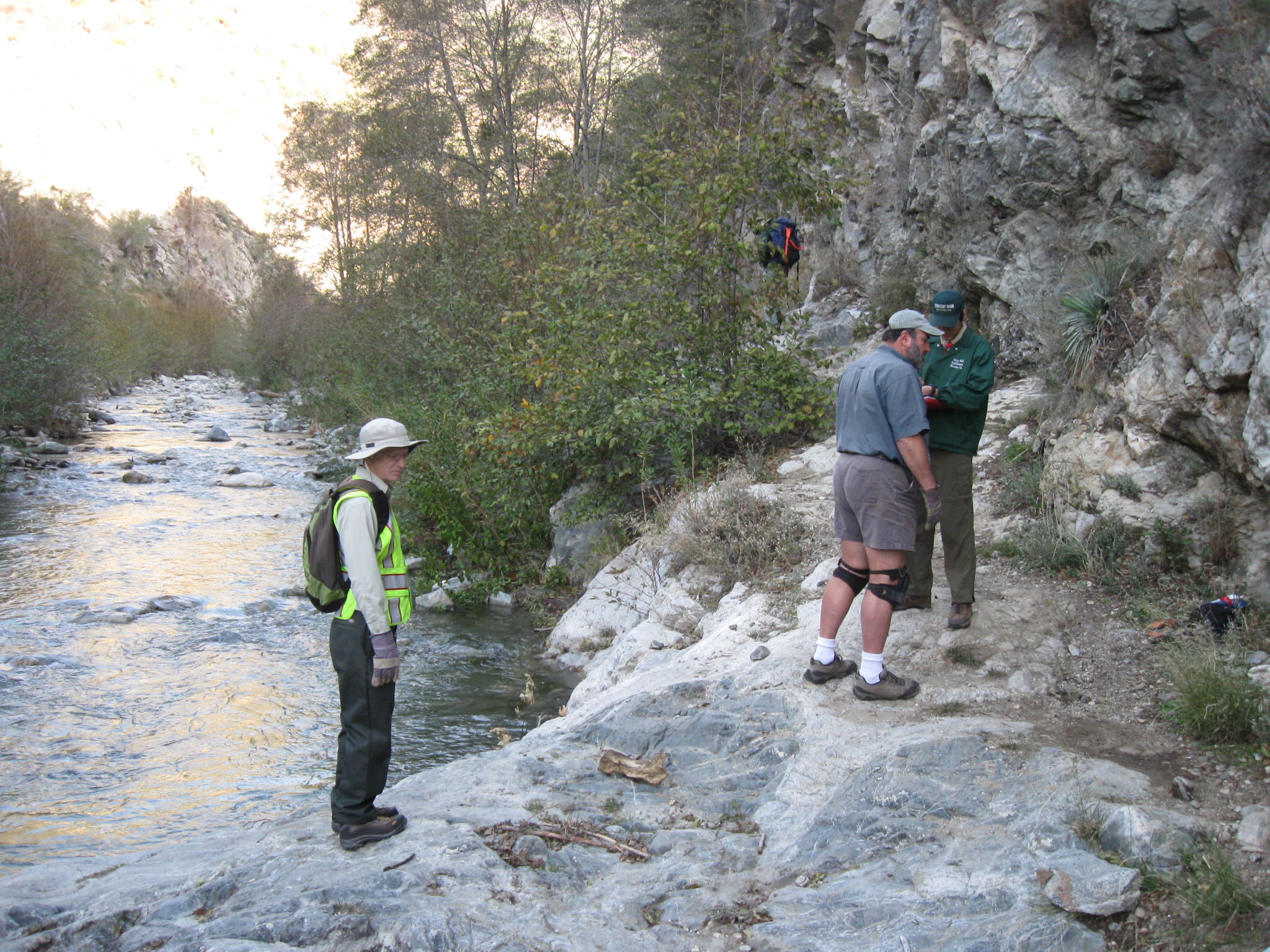 Alan and Lou arrive at the work site
 Lou takes a look at the granite outcrop that people hike over
 Some of the boulders that are tagged for being used for the steps
 A look at this section of the trail and the San Gabriel River
 Volunteers arrive for a first look at the work site
 Across the river, illegal mining is taking place
 Across the river, illegal mining is taking place
 The slope to be used for rock and gravel fill gets a bucket brigade started
 Volunteers start filling buckets
 Some of the large boulders and rocks that have been collected and hauled so far
 Trail safety monitors were posted at both ends of the work effort
 Buckets of fill are passed down the line while empty buckets get passed back
 Bernie hauls large rocks to line the river-side trail with
 Bernie examines the rock work so far
 Ben works with volunteers on extracting a boulder and chaining it up
 Ben shows how the dragging equipment is usually used
 One of the younger volunteers watches Ben demonstrating how chains are attached
 Cotter pins are reshaped and reworked with pliers
 Meanwhile a large boulder is shoved and dragged inch by inch up the trail
 On the other side of the outcrop, stair steps are being fitted
 Bron tries to create perfection with shaped rocks
 Looking along the trail work taking place
 Ben and Ben, chipping away at the rock, claiming it's hard work
 Ben about to smash his thumb with a very heavy hammer
 Boulder still getting dragged up the trail
 Bucket brigade shifts position a bit while hikers pass through
 Across the river I take a look at the work effort going on
 Across the river I take a look at the work effort going on
 Across the river I take a look at the work effort going on
 Across the river I take a look at the work effort going on
 A brip-hoist is slung and then used to haul the large boulder further along
 The grip-hoist is tied using a non-destructive padded sling
 The handle on the grip-hoist is pulled in slow steps
 The Western approach gets rocks and gravel
 The Western approach gets rocks and gravel
 Four Trailbuilders and two other adults on the Eastern approach
 I join the start of the second stage bucket brigade
 It's about time for lunch!
 Gravel is accumulated from the river, hauled in buckets, and dumped
 The Western approach has been pretty much completed!
 Tools start to get accumulated and equipment starts getting staged
 This is what the Eastern approach now looks like -- stair steps!
 While some volunteers were collecting tools ready to leave, others worked on
 A closer look at the Eastern stair step approach to the granite outcrop
 Work continues on the river trail even while most volunteers are cleaning up
 The rock and dirt slope that we started with is looking smaller and smaller
 Some volunteers continue to work on the trail
 A look at the section of trail that was filled in by volunteers today
 The Heaton Flats trail sign
 Since I never get in photographs, I thought I would take a photo of myself
 Most of the volunteers have returned to Heaton and are sorting through tools
 Tools and equipment continue to be collected at the end of the day
 A group of volunteers pause for a photograph or two
 Closer photograph of the group
 Many of the volunteers have gone on to the Rincon Fire Station or back home
 Meanwhile, the volunteers don't seem to be suffering from all the hard work!
 Tools accumulating in the pick-up truck
 More than one hat
 A test of the long distance mode on the camera fails badly
 College student volunteers pause for a group photograph or two
 College student volunteers pause for a group photograph or two
 The last photograph of the day as we say good bye to the East Fork Trail
This web site is not operated or maintained by the US Forest Service, and
the USFS does not have any responsibility for the contents of any page
provided on the http://CrystalLake.Name/ web site. Also this web site is
not connected in any way with any of the volunteer organizations that are
mentioned in various web pages, including the
San Gabriel Mountains
Trailbuilders (SGMTBs) or the
Angeles Volunteers Association
(AVA.) This web site is privately owned and operated.
Please note that information on this web page may be inaccurate.