
Saturday it was hot -- Hot! The San Gabriel Mountains Trailbuilders thought
that working up within the Crystal Lake Recreation Area, maybe it would be
cooler than working in the heat below. Perhaps it was cooler up there but
from my perspective it was still plenty hot -- Hot! -- up at six thousand
feet.
Driving up the dirt fire road toward Mount Saint Hawkins (and the destroyed
fire lookout tower and helicopter landing pad) we had to walk ahead of our
vehicles to remove rocks, boulders, and tree limbs so that the vehicles
could make it to the Windy Gap Trailhead.
Another fun day in the Angeles National Forest, the San Gabriel River
Ranger District of the United States Forest Service!
At the trailhead where we normally park a pine tree was blocking the fire
road so we called that in over the radio to the Forest Service so that they
would be aware (if they weren't already) that further access to the fire
road was blocked.
Even before we started the hike up, I was pretty tired. By the time we
had hiked up the trail to where our tools were stored, I was exhausted.
We found that the tools we had stored in a rock ravine had been buried
under tons of rocks and boulders -- we could see some handles and such
in gaps in the rocks -- so the Trailbuilders had to spend over an hour
shifting boulders to excavate the tools.
The rock slide that had crushed our tools had also covered and blocked
the trail about 100 feet from the rock wall that we were also going to be
working on today. To me, the new rock slide looked hopeless. Boulders
we couldn't possibly move were down in the trail.
Further up the trail, the rock wall that volunteers had built last year
was once again buried under tons of rocks, sand, and dirt since the
volunteers who had built the wall had run out of time and had not been
able to cap off the top of the wall to keep the hillside from flowing
downward.
There were six of us so we split in to two teams. After some of the
tools had been excavated, one team started working on clearing the rock
slide that was covering the rock wall and blocking the trail under the
rock wall, the other team worked to extract the rest of the tools and
then clear the lower rock slide from off of the trail.
It was slow going. The heat was my biggest problem -- well, that and my
age. Ha! The younger volunteers didn't seem to be having much
difficulty and worked fast and steadily, not seeming to be bothered by
the heat or altitude one bit.
While we were working we had three groups of hikers come through, each
of them commenting on the hard work that we were doing and thanking us.
As I always do I suggested to each hiker that we had tools available for
use if they were so inclined but they each declined to lend a hand.
It's neat on those rare occasions when some hiker will accept the
challenge and pick up a tool and participate for 10, 15 minutes just
to see what it's like. A lot of hikers assume that machines people sit
in build and maintain hiking trails, and when they see how they're really
established and maintained, some want to get a taste of the effort that
goes in to doing it.
After four hours the rock slide that had covered the rock wall and the
trail under it had been fully cleared, and some progress was made by
removing from the hillside a lot of the rock and sand that would have
still come down from the hillside in coming months. Even as it was, over
the next year that section will have to be cleared again and the top of
the wall will need to be built up so that we don't have to keep coming
up here and clearing that section of the trail.
After the upper slide was cleared, I took my tools down to the lower
rock slide and was astounded by the amount of work the other team had
accomplished. When we had first come across that slide which had buried
our tools I had thought it looked hopeless. The other team had managed
to clear the entire slide from the trail -- including several 800 pound
boulders some how.
The final score was that we had accomplished what we came up to do, and
Lou had managed to build up the rock wall some more on one side so that
the next time we come up we can expect to have less work to do.
We decided that we would carry down the tools we had come up with as well
as carry down the tools that we had excavated from the rock slide. That
meant two or three tools for all of us to carry. I took one of the heavy
steel rock bars and the pick I had been using and it took me an hour to
hike down to where the vehicles were parked.
When Lou passed me on the trail as I stood there gasping in the heat and
leaning over to try to keep from throwing up, he suggested that I didn't
look so good. I thought that was kind of funny coming from a guy who was
glowing brilliantly white and wavering in and out of focus like that.
If anybody needed a doctor, it was him.
Tom came by and offered to carry me down or something, saying something
about trading off. He was difficult to hear because by that time the
Ebola-infested monkeys yelling from the dead pine trees surrounding us
was making a hell of a racket. Eventually Tom gave up trying to get a
response from me and he continued on down the trail.
Half an hour later I collapsed in the shade of Ben's pickup truck, dug
out a piping hot can of Pepsi and the last of my piping hot plastic
bottle of water, then caught a quick nap while waiting for Ben and Bernie
to hike down and join the rest of us.
We stopped for cold, cold water from a pump out of an underground cistern
down in the campgrounds, then we headed down to the Rincon Fire Station
to drop off our tools. Driving across the road we parked on the side of
the highway and took a look at the foot bridge that the Trailbuilders had
built behind the Environmental Education Center.
The engineers in the group examined possible ways to establish the
approaches to the bridge, talking about what materials would have to be
brought in and how the approaches were to be built. The creek over which
the new bridge was built was dry though possibly there was water at the
upper bridge.
It's really neat. The Trailbuilders have an excellent reputation for not
only doing everything solid and going it right but for also accomplishing
without failure what they claim they can do -- and the Trailbuilders have
volunteers who are trained and qualified for practically everything that
needs to be done. It may take a year to do something -- Ice House Canyon,
for example -- but when it's done, it's done right.
Despite the exhausting effort, it was still another extremely enjoyable
day out. While volunteering, I often think about my co-workers back at
the office who sit in front of their computers every day, going home to
sit in front of the television every evening, getting no exercise,
spreading wider as the years go by.
That ain't the way I'm going to die, by golly! At least with heatstroke
I can hallucinate and scream about infected monkeys or invisible space
aliens because of the heat and exhaustion when my time comes, a thin and
desiccated corpse my Trailbuilder friends will hopefully leave propped
up against an oak tree at the bottom of whatever ravine I topple in to.
Exercise! Fun and Adventure! Heatstroke! That's for me -- and for the
San Gabriel Mountains Trailbuiders, bless us all.


 Parking near the trailhead, pine tree blocking the fire road
 The pine tree should only take about 10 minutes to chop up and remove
 I head up Winder Gap Trail and take a look back at where we parked
 Along the way there are a number of dead pine trees that need to be removed
 The trail is being diverted by this downed tree
 This section of the forest burned during the Curve Fire
 A look back at the hiking trail about half way to the rock wall project
 A look forward at some of the trail left to hike
 A larger downed tree right across the trail with an upslope incline
 A closer look at the tree -- take an hour to remove, I would say
 This downed tree can be stepped over -- another 10 minute job
 Crystal Lake is off in the distance, the water level extremly low
 A volunteer sits on a boulder resting right on top of our burried tools
 The lower rock slide has flooded on to the hiking trail -- Ug! More work!
 The rock wall is also burried under tons of rock, sand, and dirt
 Our tools are burried down under these boulders
 Tom and the younger volunteer get one tool out, chip at rock to get the rest
 Ben surveys the lower rock slide, appearse to be amused and annoyed
 We get a rock bar out from under the boulders so now we can excavate more
 The lower rock slide from a distance -- looks hopeless to me
 Lunch -- Bread, green olives, mustard, flying insects on a leather hat
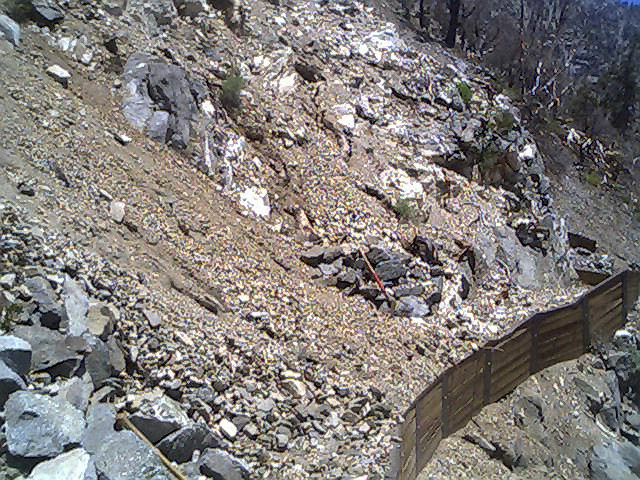 The upper rock slide after an hour of work
 Upper rock slide after two hours of work
 Crystal Lake is the light brown smudge on the middle right
 Upper rock slide after 2.5 hours of work
 I'm covered in dirt
 Woops! My camera soe times takes photographs withing being asked to
 Lou carries up rocks to cop off the rock wall
 The lower rock slide is being cleared
 The progress made on the lower rock slide is phenomenal and unexpected
 Upper rock slide, Lou builds up the wall -- about three hours of work
 Lower rock slide and much of the trail has been cleared
 All the large boulders were some how cleared from the lower rock slide
 A loot at the wood-and-metal retaining wall for the hiking trail
 Down below at the campgrounds we pause for cold water from the cistern
 Inspecting the bridge being the Environmental Education Center
 Inspecting the bridge being the Environmental Education Center
 Discussing the approaches to the bridge
 Water in creek behind the Environmental Education Center
 Water in creek behind the Environmental Education Center
This web site is not operated or maintained by the US Forest Service, and
the USFS does not have any responsibility for the contents of any page
provided on the http://CrystalLake.Name/ web site. Also this web site is
not connected in any way with any of the volunteer organizations that are
mentioned in various web pages, including the
San Gabriel Mountains
Trailbuilders (SGMTBs) or the
Angeles Volunteers Association
(AVA.) This web site is privately owned and operated.
Please note that information on this web page may be inaccurate.