
Today was a special trail project involving the San Gabriel Mountains
Trailbuilders and Ben Kvisler's Eagle Project where 10 very nice wooden
steps were installed at the East Fork Trail head, the trail which gives
access to the San Gabriel River and the famous "Bridge To Nowhere."
And what a great project it was! As can be seen in the extensive
photographs, that section of the trail had been fairly steep with points
of erosion which slowly got worse as time progressed, and while the first
three or four miles of the trail has seen extensive repairs and maintenance
over the past two years, the trail head was not seriously addressed until
today.
The volunteers met at the U. S. Forest Service Gateway Information Center
down at the base of the mountain along Highway 39, collecting at and then
leaving the rally point earlier than usual, heading up the mountain to the
Rincon Fire Station for tools, equipment, and the day's first safety review.
After Rincon we turned around and headed to Heaton Flats and the East Fork
trail head. Once there the tools and equipment were unpacked and sorted
through and then the Eagle Candidate called together the volunteers for
the more detailed safety rundown offered by Ben.
Safety is always the first priority for the Trailbuilders, and every work
day begins with a safety review involving the tools, equipment, and the
local flora and fauna regardless of how experienced or inexperienced the
volunteers are. Even when it's just long-time Trailbuilders there is a
safety review, and when the day's efforts are technically involved such
as today, the safety rundown takes time but is well worth it.
After the safety review, the Eagle Candidate picked up the coordination
of the day's effort. Today would see the entire section of the trail head
addressed in a number of ways, all of which had been meticulously measured
and planned step by step on previous visits by the Candidate over previous
weeks.
The East Fork Trail which leads to the "Bridge To Nowhere" is a
heavily used and much-loved trail, and on any given week end, hundreds of
hikers use the trail regardless of the weather and regardless of how high
the river water is. On top of the high number of hikers, there are often
something between 50 or some times 70 bungee jumpers that use the trail
to leap from the bridge.
Some sections of the trail literally had hikers walking along a four-inch
wide ledge on a rock face with a ten-foot drop if they fell, conditions
which made taking pets and children on the trail somewhat hazardous however
all of those problems had been addressed by the Trailbuilders and numerous
other volunteers, leaving only the trail head to be made safer.
Above where the stair steps were to be installed, a deep trench was dug by
volunteers in a diagonal across the trail and then volunteers located and
dragged large boulders and rocks to be planted edgewise in the trench while
other volunteers collected rocks, gravel, and sand in buckets to lodge the
up-ended boulders solidly in to place.
Once everything was planted, more gravel and small rocks were carried in by
volunteers to spread up and down the upper section of the trail where the
newly-installed waterbar was located so that the trail head will no longer
erode anywhere nearly as quickly as the previously untreated trail head.
While that was going on, another team worked on utilizing a gasoline powered
electric generator so that a serious electric drill could be used to place
slanted holes in to the 10 wooden stair steps.
The drilling required the repeated application of an ecologically friendly
lubrication to be applied to the drill bit when the drill was turned off,
and because volunteers are utilizing powered tools, all of the required
safety equipment and clothing were utilized – eye protecting goggles, long
shirts, long pants, gloves, steel-toed shoes, fire extinguishers, medical
kit, all the materials that are needed for safe use of powered tools.
Part of the day's fun was drilling on a blue plastic tarp to attempt to
collect as much of the sawdust and wood chips as possible, an effort to
ensure that hikers, bikers, campers, climbers, and illegal miners would
not be able to see any mess left behind, all people will see are awesome
new steps.
While that all was going on, other volunteers were digging out the trenches
down the trail head where the ten steps would be embedded, and as each step
came off of the drill platform, each step was set in to position, gravel,
rocks, and sand were used to solidly seat each step, and re-bar was used
to assure as little settling movement as possible while the steps are used.
Finally while all of that was going on, the Eagle Candidate Ben Kvisler
kept coordinating the effort, walking (and some times running!) to and
from the project's ends, directing the effort, kicking idle volunteers
back in to motion, watching for safety problems, and making sure that the
project would be completed in the fairly short period of time available.
Everything went very well, everything was accomplished in time which speaks
volumes about the planning and the implementation effort. The new steps look
awesome, and hikers who had passed the effort while it was under way
returned in the afternoon to find the new steps, many of them joking about
being lost now that the trail head looks so different, and many people
thanking the volunteers for that effort.
These stair steps and the erosion protection that was put in today should
last for decades to come, and only minimal maintenance should be required
to ensure that the steps are cleared of soil over the years. In all, these
new steps greatly improve safety on the trail and visitors can see that
volunteers really can make a huge difference which benefits community.
And what fun it was, too! One of the younger volunteers was a, er, um,
"rambunctious" volunteer, who liked to walk along the ruins
located at the trail head, something that isn't safe since it means a
possible fall of some 20 feet, but I posted myself on the wall and made
him stop. LOL! It seemed to me that everyone had fun.


 High density photograph: A look at the trail head while being surveyed
 High density photograph: Measurements are taken during the surveying
 High density photograph: Eagle Candidate and Bron take measurements
 High density photograph: Heaton Flats trail head sign
 High density photograph: Sheep Mountain Wilderness sign at Heaton Flats
 High density photograph: Duplicate of the previous photograph
 High density photograph: Another look at the trail head from the bottom
 High density photograph: A look at the trail head where the pavement ends
 High density photograph: A longer survey look at the trail head
 High density photograph: The trail head seen from end to end
 High density photograph: A close look at the end of the pavement
 High density photograph: A look at some of the ruins at the trail head
 High density photograph: Flagging is placed during the surveying
 High density photograph: A level is used to measure points along the trail
 High density photograph: A look at boulders placed along the side of the trail
 High density photograph: Looking down on the trail from the top
 High density photograph: These expensive wooden steps were donated!
 High density photograph: A final look at the stairs after being installed
 High density photograph: Another look at the final steps
 High density photograph: Another look at the final steps
 High density photograph: A final look at the erosion controlling gravel
 High density photograph: A view of the final steps from the top
 High density photograph: A closer look at the gravel and stone wall retainer
 High density photograph: Another look much like the previous photograph
 The volunteers at the Rincon Fire Station to collect tools
 Gathering at the Heaton Flats trail head
 Tools and equipment staging up
 Going over the project
 One of the volunteers who liked walking along the ruins' wall
 Ben goes through the tools and equipment that will be used for safety
 Ben of the Trailbuilders also covers the local flora and fauna
 Getting started ojn the project
 Considerable progress on the trail head is done quickly
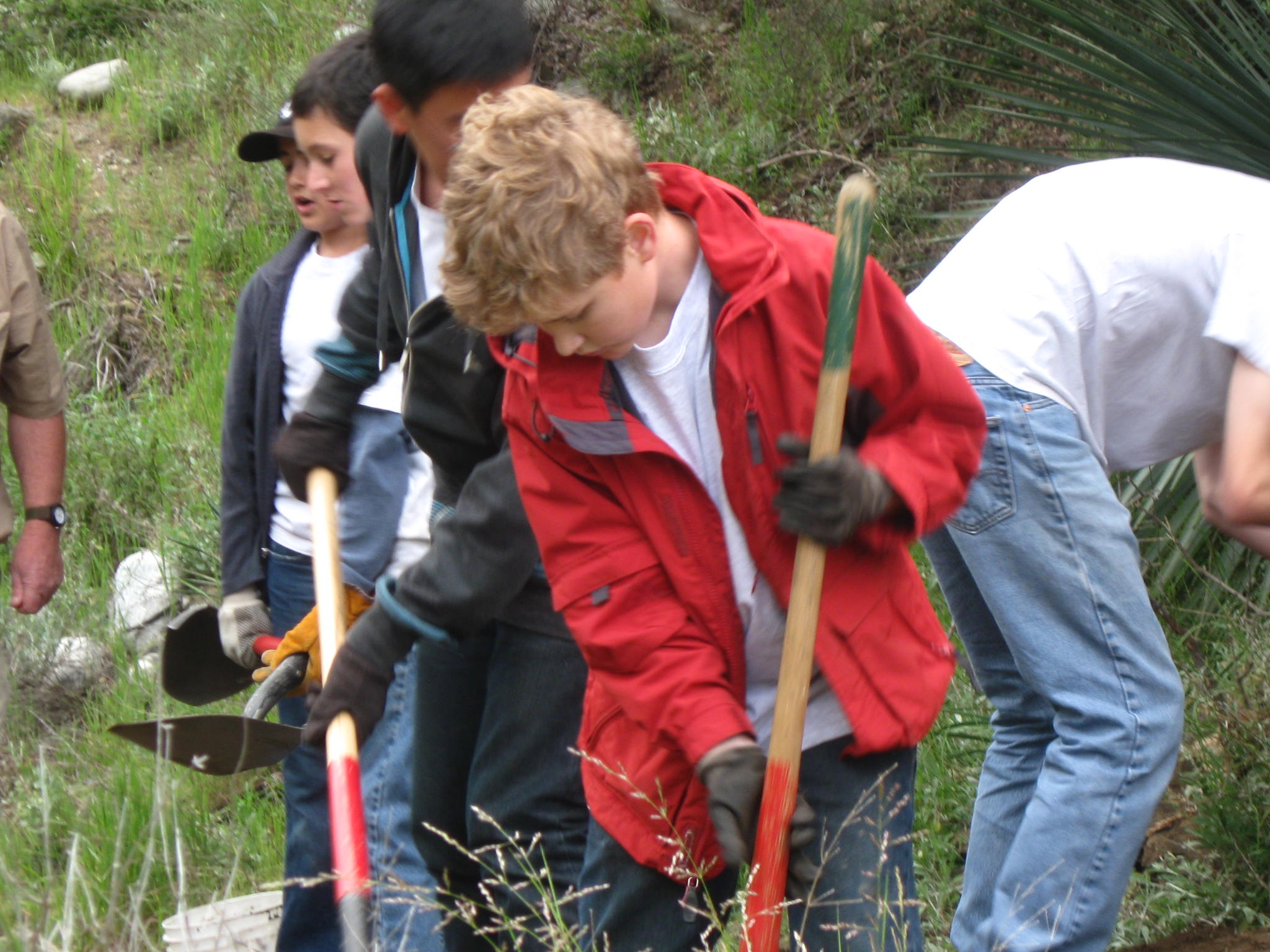 Plenty of long tools to go around, shovels, McLeods, everyone kept busy
 Another of the volunteers working with a long tool
 Eagle Candidate running to take care of a project issue
 More progress being made along the trail head
 Ben covers the use of the ecologically friendly drill lubricant solid
 Ben applies some of the lubricant to the drill bit
 Ben directs the starting drill holes to ensure they're placed at a slant
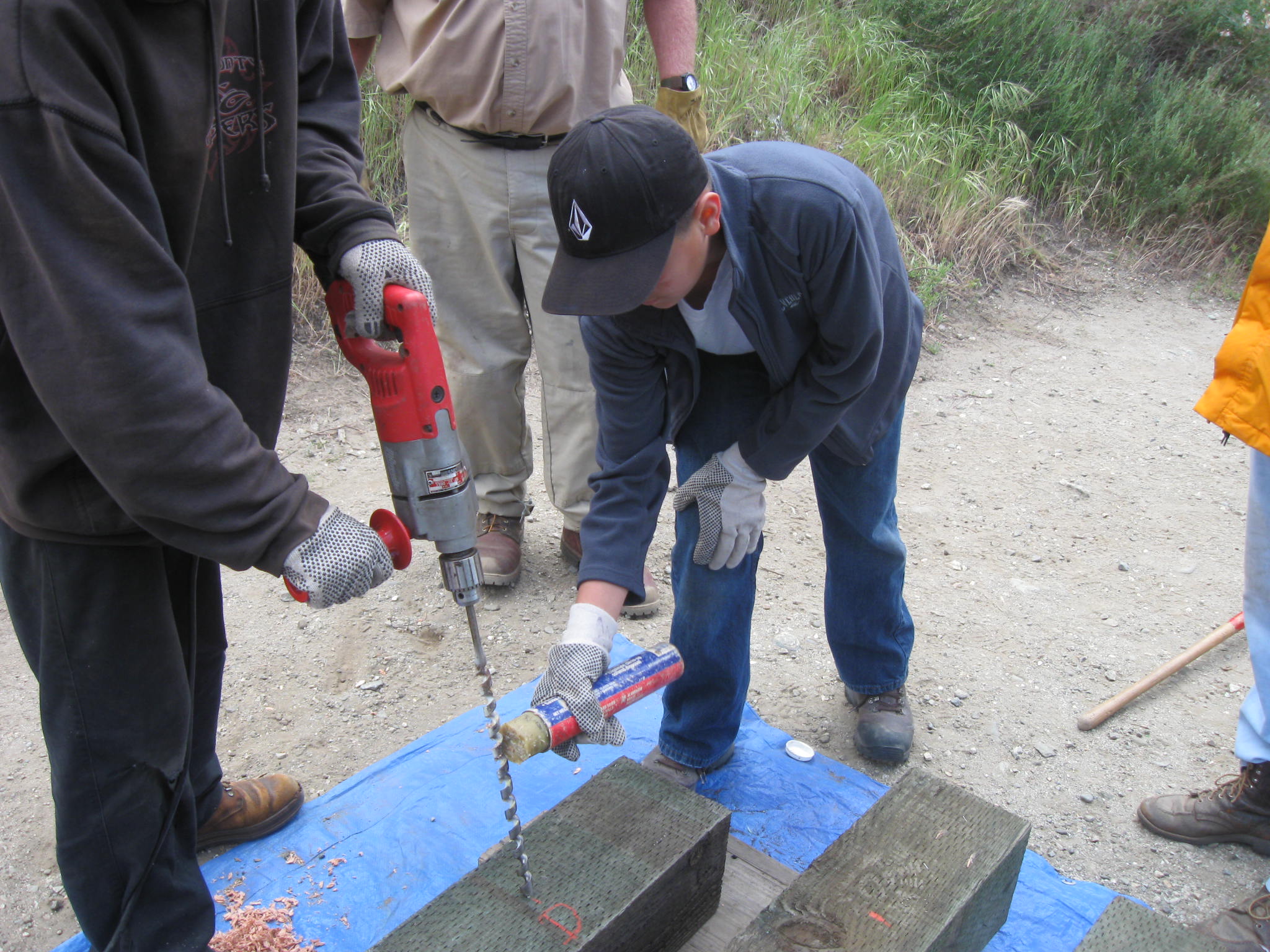 Young volunteer with gloves assists in applying lubricant solid
 Excellent look at the gravel and rock installed to curb erosion
 The waterbar's trench gets laid with rocks
 You can see how extensive the drainage on the new water bar is -- done right!
 Hard work continues on the trail head
 An illegal miner squatting in the forest watches the effort with his dog
 10,000 buckets of gravel, rock, and sand! An awesome effort
 Lean in to it! Get friendly or get angry with one's shovel
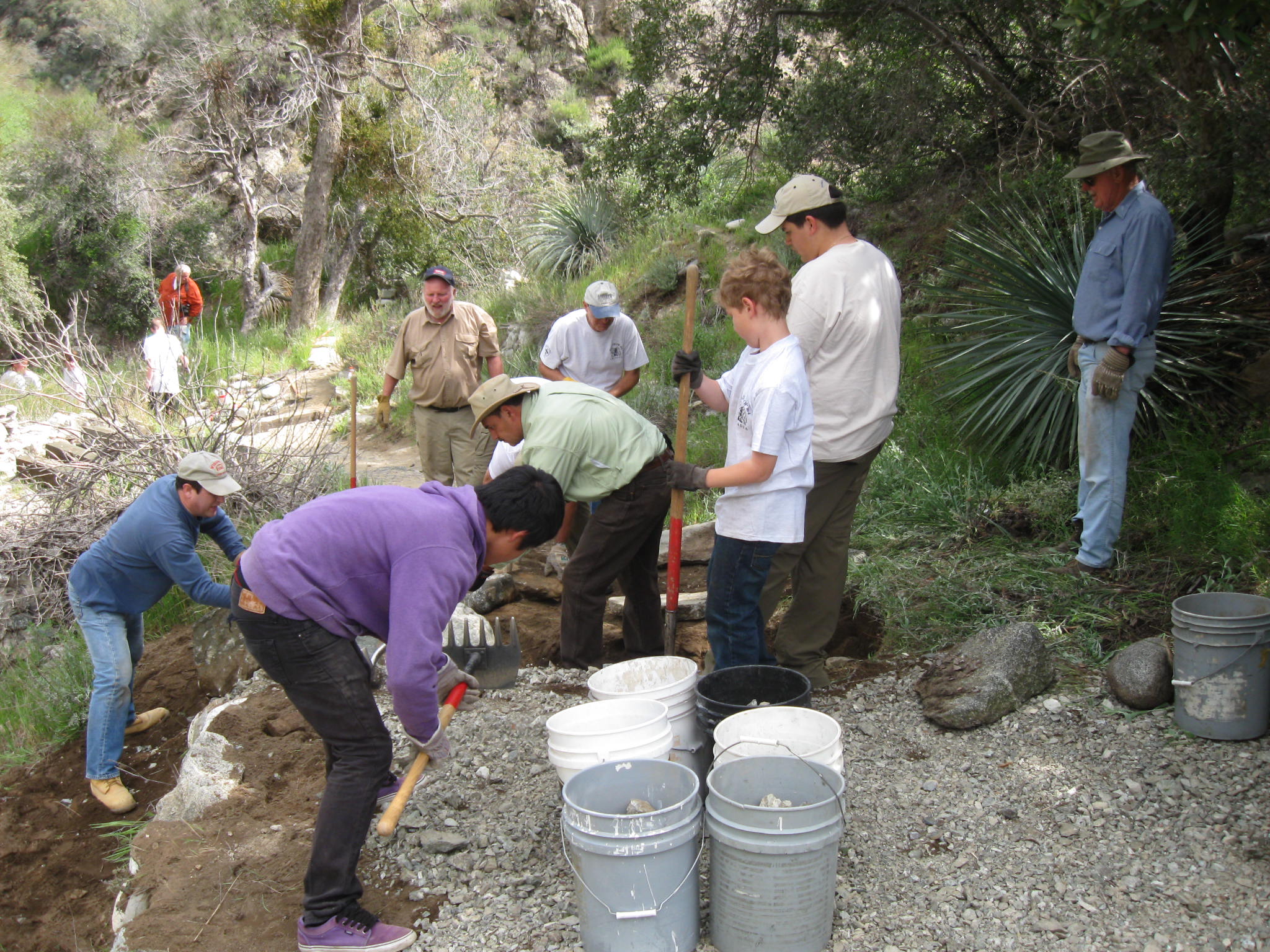 A good look at the gravel and rock erosion effort as it progresses
 The stair steps start to be installed
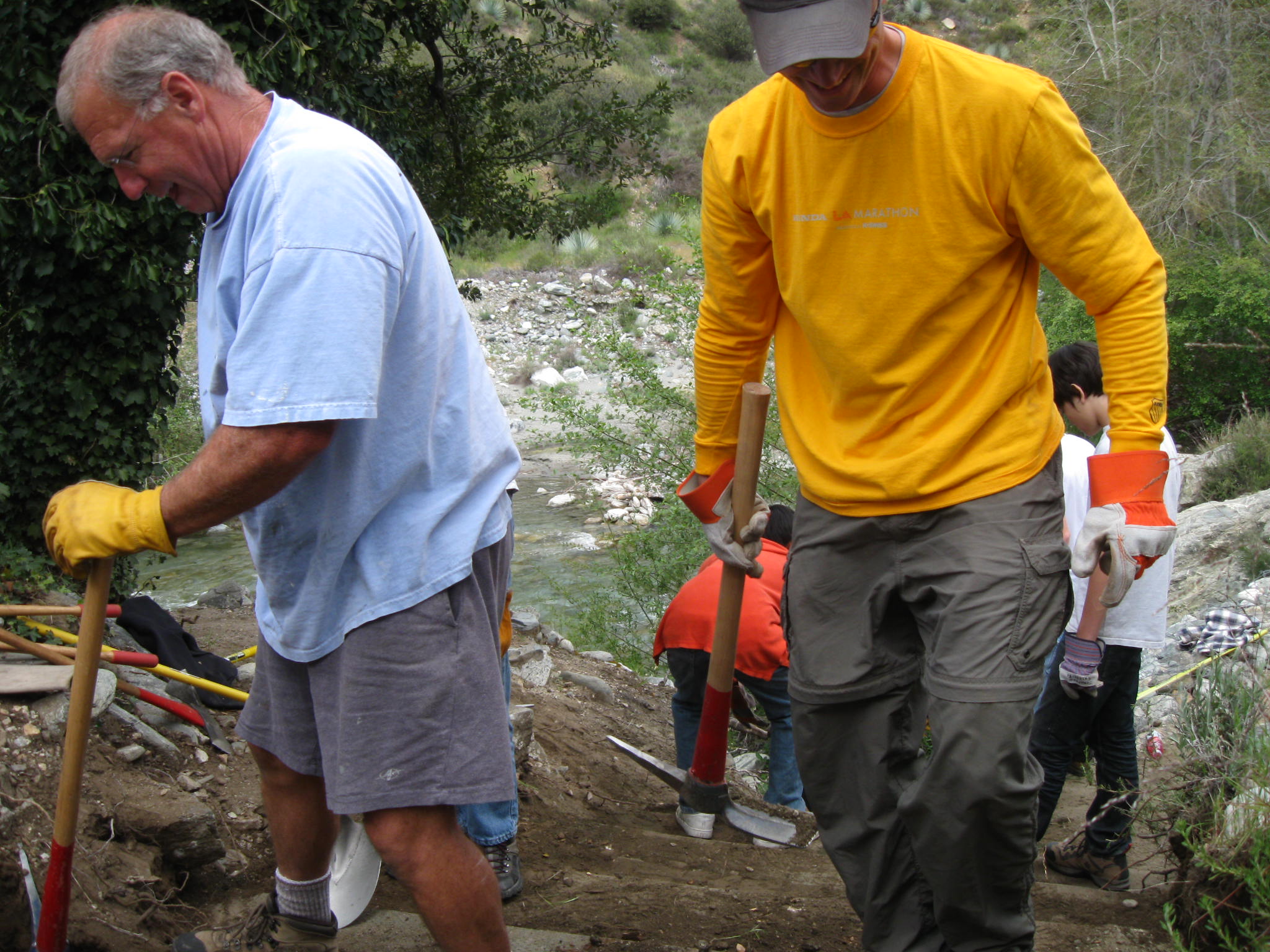 Two entrenching tools, one for each hand!
 The finished waterbar looks awesome!
 A hiker comes up the steps installed so far, examines them and comments
 More hikers come up the steps as they're installed
 Either of the steops so far!
 All ten steps have been installed, a first look at the whole project
 A volunteer takes a drink break
 The same volunteer takes a seat on the newly installed stair steps
 A final look at the volunteer
 Meanwhile the stream that feeds the drainage pipe below the trail head
 A closer look at the stair steps after being installed
 An even closer look at the stair steps
 Take a look at the rock retaining wall that was build to stall erosion
 Safety flagging was installed to let hikers know to pay attention
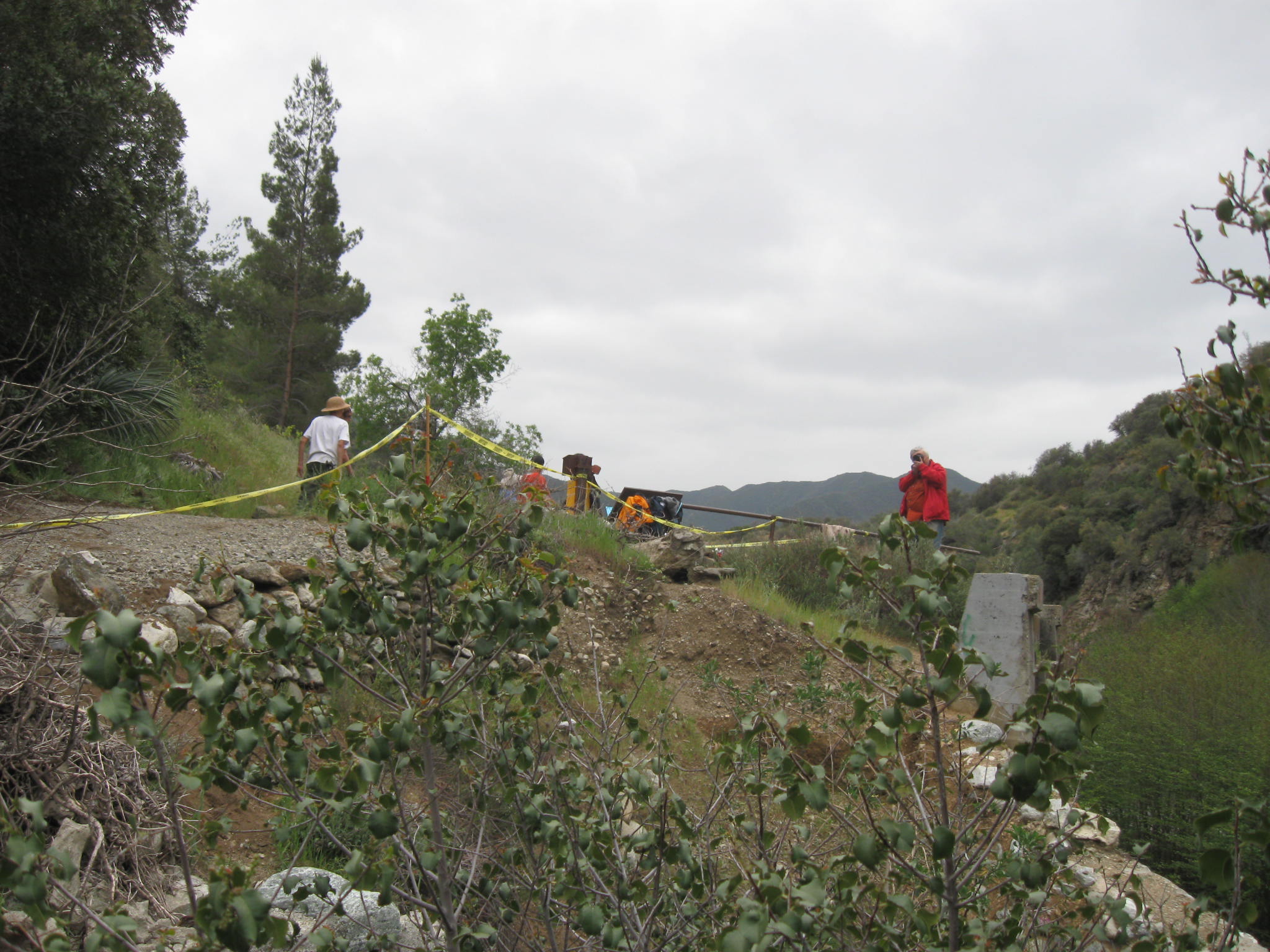 More safety flagging to keep people away from the cliff edge
 High density photograph: Pausing for a group photograph
 High density photograph: Pausing for a group photograph
 High density photograph: A look at the whole stair step project
 High density photograph: A final closer look at the completed steps
This web site is not operated or maintained by the US Forest Service, and
the USFS does not have any responsibility for the contents of any page
provided on the http://CrystalLake.Name/ web site. Also this web site is
not connected in any way with any of the volunteer organizations that are
mentioned in various web pages, including the
San Gabriel Mountains
Trailbuilders (SGMTBs) or the
Angeles Volunteers Association
(AVA.) This web site is privately owned and operated.
Please note that information on this web page may be inaccurate.