
Today was a cold, wet, foggy day so there were only three of us working
at the lower bridge going in at the Environmental Education Center at
Rincon Fire Station in the Angeles National Forest within the San Gabriel
River Ranger District of the USFS. Despite the rain and everything being
somewhat wet, we got a great deal of work done!
We inspected the upper bridge to see how it was taking care of the large
volume of water that the new concrete we put in was shipping and everything
was working the way the San Gabriel Mountains Trailbuilders' engineers
designed it.
While working today we noticed that some time in the previous week during
the rains the water level along the creek had been much higher than it was
today but despite the heavy surge of water, the upper bridge was in fine
shape and handled it all perfectly, as expected.
Down below at the lower footing we found the new footing that is going in
was flooded. We also found the gate to the Environmental Center to be
improperly locked so we had to hand carry all of our tools an additional
300 feet or so -- just more work for us and just a minor annoyance.
Patrick (USFS) stopped by in a new Rubicon vehicle that maybe the USFS is
looking at utilizing in the area. The new vehicle looks like it's a
perfect, extremely safe vehicle for safety patrolling and Patrick really
looked high-core, rugged, and extreme in the new vehicle.
To say that I was jealous is an understatement! The rugged, solid vehicle
is perfect for Patrick, it seems to me, and perfect for safely working in
these canyons. But truth be told, I always prefer ancient, broken down
but reliable motorized dinosaurs from the 1960's and 1970's Ford Vehicles
era, and at final reflection I will also love ancient, single-speed bicycles
the best.
The first thing that was done was Tom cleared out the blockage of the
temporary dogbone foot bridge so that the heavy volume of water wasn't
shipping over the top of the temporary bridge. That drained the lower
footing that we needed to excavate so we were not having to work in a
flood.
The existing dogbones were peeled off of the stack and set aside so that
we could dig into the near hillside. We needed to establish a secondary
stacked cube of 60 pound dogbones locked into the first stack and also set
into the hillside itself for additional anchorage.
To be sure this doubles the work, doubles the materials, but the SGMTBs
design things to last through time and through heavy flooding and heavy
foot use and the time and effort spent now reduces the maintenance needed
in the future.
Tom and Mike utilized the LASER leveler to ensure that the excavation for
the secondary tie-in stack of dogbones was going in reasonably level and
that it matched the height of the footing assembly on the far side of the
creek.
Careful measurements, marking points along the stack, and constant
re-measurements ensured that the near footing was as close to equal to the
footing on the far embankment as we could make it. It may be that a
quarter-inch shim will need to be placed into the new stacking eventually.
Because three very large boulders had to be removed while rebuilding the
dogbone footing stacks, tying the new one into the embankment and then
filling it all in again, we were short a fairly large volume of dirt --
so we carried gravel, rock, and sand in from various other points around
the surrounding forest in buckets until the new footing was completely
filled in.
In all it looks really great! Some additional measurements and adjustments
will have to be made and eventually the very large boulders that have been
moved around will be placed at the face of the base of the footing to slow
down the creek water before the water impacts the footing, and then the
actual bridge itself will be built and assembled on the footings.
The amount of work that we got done was impressive, more so since I spent
a lot of time standing around while the engineers did their measurements
and adjustments. We could have used a Boy Scout or two to do some hauling
but we got the work done early so we actually completed the work and left
something like two hours earlier than usual.
And it was fun, as usual!
Photographs are provided at the bottom of this web page. A short
video of the photographs is also provided at the end of this page.


 The lower bridge footing before we begin work for the day
 The temporary dogbone bridge is flooded
 And the bridge footing that we'll be working on is also flooded
 A high volume of water is coming down the creek
 Tom inspects the upper bridge to see how it's handleing the water
 A closer look at the upper bridge
 This is the amount of water currently going through the creek
 The new concrete is all in place and working perfectly
 Looking down stream at the flowing water
 Mike comes up to also inspect the upper bridge
 And Mike moves some boulders around where the upper bridge railing is
 Mike examines the water flow through the upper bridge
 Back down at the lower footin before work begins
 We start excavating the near enbankment
 The existing dogbone footing is removed and we dig, dig, dig
 We start laying in the new dogbones after everything is level
 I stacked up dogbones and then we did some more measurements
 During lunch I walked to the San Gabriel River to see how much water
 The rain came and went and along with it the fog came and went
 A new sign instructs Elmers where to cross the river
 The river has a large volume of water filling up the basins below
 Morris and San Gabriel basins are starting to fill up very slowly
 The footing is completed after a short lunch break
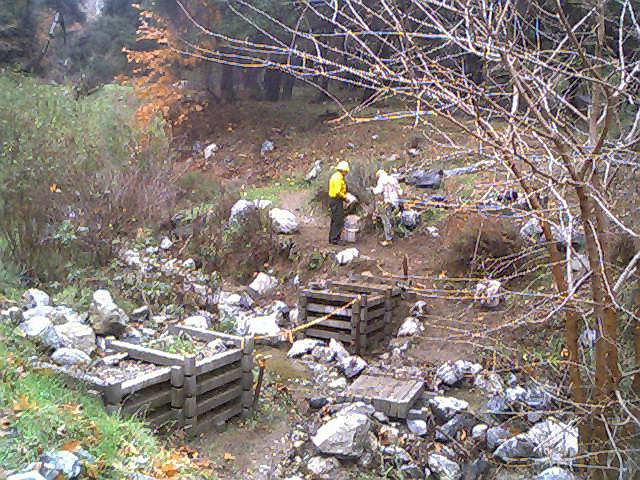 A final look at the entire lower bridge area as it currently exists
This web site is not operated or maintained by the US Forest Service, and
the USFS does not have any responsibility for the contents of any page
provided on the http://CrystalLake.Name/ web site. Also this web site is
not connected in any way with any of the volunteer organizations that are
mentioned in various web pages, including the
San Gabriel Mountains
Trailbuilders (SGMTBs) or the
Angeles Volunteers Association
(AVA.) This web site is privately owned and operated.
Please note that information on this web page may be inaccurate.