
It was a cold, dark and stormy day - perfect for volunteering in the
Angeles National Forest! Hard, hot, sweaty work gets a lot easier when
it's cold and rainy, and the noise of the heavy rains helps to drown out
the moans of 31 Boy Scouts dragging four hundred pound boulders from one
end of the forest to the other, building the rock wall that would comprise
the flood spillway and hiking trail on this project.
And what fun it was, too! At least I thought it was fun, watching all that
hard work being done from a comfortable distance, safely and warmly wrapped
in my cozy jacket sitting under the umbrella of a huge oak tree.
Ha! Actually there were two projects for today, one of which comprised of
Janette, Lou, Stephen, Tom, and myself heading over to the stairs leading
down to Crystal Lake where it had been reported that a very large tree had
fallen in to the drainage culvert along side the stairs, something that
could not be left there since the rainy season was upon us, and having
the culvert blocked would have re-flooded the stairs and the benches
placed along them with two feet of mud - something that had happened
in the past and required exhaustive effort to remove and clean up
previously.
Today's volunteers gathered at the Rincon Fire Station to collect our
tools, go over the plan for the day, and basically stage up for the
projects. When everything was set to go we headed up to Crystal Lake,
meeting once again at the parking lot for the open-air amphitheatre at
the trailhead for Pinyon Ridge and Soldier Creek trails.
After the safety meeting, the team I was on split off and headed toward
the lake, leaving the 31 Boy Scouts, adults, and other San Gabriel
Mountains Trailbuilders to carry their equipment up to Pinyon Ridge.
Upon reaching the stairs leading down to the lake, we got our first look
at the tree clogging up the rock drainage culvert. Yikes! 24 inches
across and about 12 feet long weighing many hundreds of pounds, wedged
in between the two rock walls that comprises the culvert. To make things
worse, the far end of the tree that had fallen had broken off and slammed
in to the corrugated metal funnel spillway at the end of the rock culvert,
closing off the entry to the metal spillway entirely.
(Photographs of the clogged culvert are provided below, and tomorrow's
clean-up project available on this web site provides further photographs
of the culvert after it has been entirely re-opened.)
The problem wasn't so much as how to extract the tree from the culvert
but how to do it safely and without damaging the rock walls.
To start, we removed much of the accumulated bark, splintered wood, dirt
and rock surrounding the tree so that we could get a better look at the
problem, then we used rock bars to leverage up one end far enough so that
we acquired an air gap on either side of the end of the tree. Once we
acquired an air gap, we used the heavy metal rock bars to wedge the tree
in to position so that it would not move once the chainsaw got to work.
We did this repeatedly, moving the bars down the length of the tree,
slicing off sections piece by piece until we were left with a six foot
section, then we leveraged the remaining tree section up out of the
culvert, building a rock base under it rock by rock until enough of the
tree was over the lip of the culvert, then we applied pressure to roll
the remaining section slowly out, over the wall, bouncing off of the wooden
bench along the wall, and finally to rest on the stair landing.
This effort took several hours and a lot of hard work, enough so that much
of the remaining rock, mud, bark, and shattered wood was left in the
culvert for the day. A visual inspection of the corrugated metal sluice
box showed that it was pinched shut anyway and as such clearing the rock
culvert that drained in to the metal box was pretty much pointless.
Fact is we left a hell of a mess with very large sections of bucked up
tree left standing on the stair landing, rolled out of the way, of course,
but still kind of clogging up the walk way. (We eventually informed the
USFS that someone is needed to buck up the sections further and carry
them up and out so that they can be used as fire wood.)
There was some amusing confusion among this effort over the radio because
we got a call about a number of Boy Scouts who had joined our crew working
on Pinyon Ridge accidentally. We were asked to leave our project and head
to Pinyon Ridge to inform the crews working up there that some of them
should be down at the Rincon Education Center.
So Tom was dispatched to alert the crews up there. After he had gone,
the call came in over the radio that all of the Boy Scouts had been
accounted for and that there was no need to check for misapplied Boy
Scouts. Woops! Tom drove a mile or so, hiked in to the work site only
to find that everyone there was supposed to be there, returning to our
tree removal project after about 30 minutes or so.
Ah, well. Lots of activity takes place in the forest on week ends with
lots of projects that keep things clean and relatively safe, much of
which visitors to a forest are often unaware of. When working with
fairly large numbers of volunteers on projects, it happens often enough
that people join projects they were not originally planning to solely
because they dispatch themselves with other groups that they mistakenly
believe are heading toward their own expected projects.
It's kind of like getting in line to board the jet airplane along with
everyone else and winding up in Ohio - a place where nobody wants to go
but gets there solely by accident. Volunteers can sign up for removing
rock dams built illegally across the river and find themselves joined
up with the crew that boards the helicopters to be air dropped on a
fire line if they are not careful which can be embarrassing and amusing
by turns.
Upon rejoining the main project we discovered that lunch was not being
served yet so we looked for things we might do in the mean time.
Walking further up the trail Stephen and I discovered that we could
not locate the trail. The trail came to an abrupt end - which is
impossible since I knew the trail was out there somewhere.
We called Tom over to help us find the trail and he and Stephen
discovered that a very large tree had fallen directly along the trail
right where the trail makes a left turn. A walk further along the newly
re-discovered trail showed that that was the only tree down so we
decided we would cut that up and remove it.
Lunch was some kind of hideously rotting animal flesh served on bread
with cookies, fruit, and various refreshing drinks. Since I don't eat
my fellow furry forest friends, I opted for two bagels, two tart green
apples, and something cold to drink. Joy! Lunch was good.
After lunch the Boy Scouts got back to work on the rock spillway and
trail, and Lou, Stephen, Tom and myself went to work on cutting up the
large tree down along the trail. That tree took 12 cuts and a lot of
work with the rock bar to elevate the last half of the tree high enough
so that we could section it up without fouling the chain in the dirt and
rock under it.
The tree had fallen on top of a huge boulder and then the tree glanced
off and dropped along the trail. Since the boulder was now leaning in
to the trail, we leveraged the boulder back to where it had been, cleaned
up the bark, and returned our equipment to the pickup truck.
Rejoining the main project, we stood around in the rain and tried to stay
out of the way. Lots of motion is involved in these kinds of projects
with two grip hoists being used with heavy cables and chains to drag big
boulders around which then have rock bars used to position them in to place.
While that's going on crews are shoveling rocks and dirt, moving hundreds
or thousands of pounds of materials to establish the trail on top of the
spillway.
While that's going on, the approaches to the rock wall that abuts the new
trail section was being worked, knitting together the two ends of the trail
and pretty much sewing the new spillway seamlessly in. The result of all
this is a very good looking new rock wall holding up a section of the
trail that routinely used to get flooded out with the seasonal rains.
Hikers and bicyclists can now proceed along the trail - and Pinyon Ridge
forms a large loop which is very popular - without having to step
carefully from rock to rock.
The San Gabriel Mountains Trailbuilders do a lot of such projects,
working with groups of other volunteers, and coordinating as much of
the effort as possible prior to such projects. Actual hiking and nature
trail miles of reworked trails can be low in number some years, very high
in number on other years. It all depends on the work required.
With the passing of the Curve Fire and the follow-up flooding, trail
maintenance has relied upon projects such as this one. Bridges across
flooded-out trail sections, missing trail signs, removing rock and mud
slides, removing downed trees across not only burn areas but across
areas where the bark beetle infestation has killed trees, some years
we end up re-establishing the basic infrastructure so that safe access
to the trails is re-established.
Once trails are re-opened, then the regular maintenance of trails can
resume, and the number of miles for the work starts counting higher
once again. As trail maintenance continues, the occasional
infrastructure project must be scheduled in - such as clearing
drainage culverts like we did today, or replacing the foot and
equestrian bridge such as we are doing this month.
After the last shovel full of rock and gravel was moved in to place, the
Boy Scouts picked up their tools and equipment and headed toward the
trailhead. There was a brief meeting at the parking lot and then we
all headed down to the Rincon Fire Station where the tools were washed
and stored away for next time.
And what fun it was, too!


 We meet at Ranch Market early in the morning and have breakfast
 At Rincon Fire Station the tools are gathered
 Clouds move in and we get a bit of rain before we head to Crystal Lake
 Still collecting tools and equipment at Rincon
 We take a quick look at the Laurel Gulch bridge construction so far
 The Boy Scout in charge gives a brief run down on what's going on today
 We gather at Pinyon Ridge trailhead
 A look at the start of Pinyon Ridge and Soldier Creek trailheads
 We start with a safety meeting covering how to safely use the tools
 Safety meeting continues
 Safety meeting while the fog starts to roll in
 Here you can see the entire work crews before the project begins
 A look at Pinyon Ridge and the rain clouds that are starting to move in
 The walk way to the ampitheature has been reworked
 A smaller crew breaks off to clear the tree down in the rock culvert
 First look at the tree down in the rock culvert
 Tom covers the safety points on the chainsaw that we will be using
 The first cut is made after the tree is elivated
 First cut continues as Tom watches
 The 2 foot sections take some time to carefully cut
 First section is done, now the second section after the tree is elivated again
 Less than half of the tree has been pulled out so far
 The tree gets elivated again to make room for the next cut
 Wedges are used to keep the cut from closing up
 The tree has been completely removed from the rock culvert
 Dark: The rock spillway and trail project so far
 Dark: Boulders get chained up and hauled in to place
 Dark: Two grip hoists are used to drag boulders around the project
 Dark: The rock wall for the spillway takes shape
 Dark: Another boulder is chained up and moved in to position
 Dark: The trail is worked and docks and dravel are moved to where it's needed
 Dark: Boulders are collected from all over the area
 Dark: Working in the rain. What fun!
 Rocks are carried around by hand as well as get dragged around on the ground
 Dark: A very large boulder is chained up and getting moved
 Dark: Further up the trail there is a downed tree along the trail
 Lou, Tom, Stephen and I take a look at the downed tree
 Dark: We break for lunch!
 Lunch is held under the only structure in the area to get out of the rain
 Dark: Stephen starts the work on the downed tree removing limbs
 Dark: More limb removal on both sides of the downed tree
 Dark: The last few limbs are removed
 A brighter photograph of the tree limbing effort so far
 Limbs removed so the tree trunk can be safely sectioned up
 Bucking starts on the up-hill side of the downed tree
 First cut is done and rolled away so the second cut gets started
 We are finished with the downed tree across the trail and only need to clean up
 Dark: Clean up of the downed tree gets started
 Dark: Back at the rock spillway and trail project
 Dark: The trail across the spillway looks great! (Too dark to see well.)
 Dark: A lot of materials was carted to the work site in buckets
 Very dark: The rock wall so far (can't really see anything.)
 Very dark: The far side of the rock wall
 Very dark: Moving the last boulder in to position (very difficult to see.)
 Very dark: Scouts start to collect some of the tools (very difficult to see.)
 Very dark: Carrying some of the tools down (very difficult to see.)
 Back at the trailhead after the work has been completed
 A look up the road from the trailhead
 Not every one is back from the work site yet
 Dark: Getting the tools loaded in to the pickups
 Dark: A look at the heavy clouds that are off past the horizon
 One final gathering before we head back down to Rincon
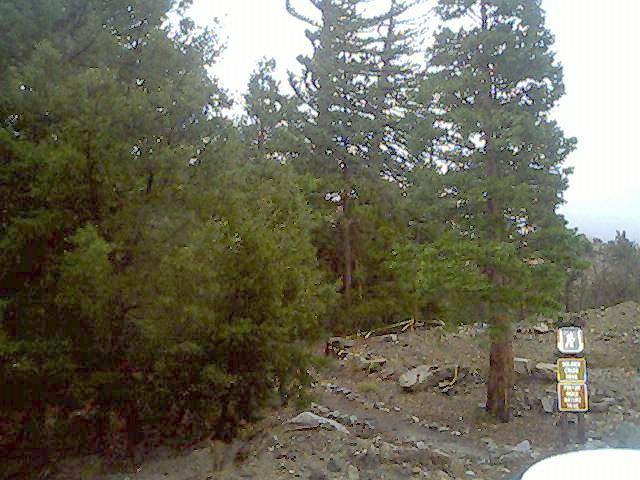 Dark: A last look at the trailhead before we leave
 Dark: A last look at the forst
 Back at Rincon the tools get put away
 Tools get carried to the fire hydrant to be wasked off
 Washinn off the tools before they are put away
This web site is not operated or maintained by the US Forest Service, and
the USFS does not have any responsibility for the contents of any page
provided on the http://CrystalLake.Name/ web site. Also this web site is
not connected in any way with any of the volunteer organizations that are
mentioned in various web pages, including the
San Gabriel Mountains
Trailbuilders (SGMTBs) or the
Angeles Volunteers Association
(AVA.) This web site is privately owned and operated.
Please note that information on this web page may be inaccurate.